


Page 14 - EJMO-9-3
P. 14
Eurasian Journal of
            Medicine and Oncology                              Progress in the research of pathology and therapy in liver fibrosis


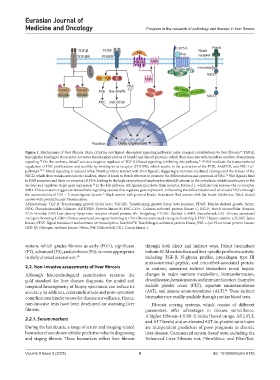
            Figure 1. Mechanisms of liver fibrosis. Main cytokine and ligand-dependent signaling pathways make unequal contributions to liver fibrosis.  TGF-β,
                                                                                                       14
            through the binding to its receptor, activates the phosphorylation of Smad2 and Smad3 proteins, which then associate with Smad4 to mediate downstream
            signaling.  On the contrary, Smad7 acts as a negative regulator of TGF-β1/Smad signaling, inhibiting this pathway.  PDGF mediates the transcriptional
                  30
                                                                                      31
            regulation of HSC proliferation and motility by binding to its receptor (PDGFR), which results in the activation of the PI3K, Akt/PKB, and PKC-Ca
                                                                                                            2+
            pathways. 32,33  Notch signaling is induced when Notch proteins interact with their ligands, triggering γ-secretase-mediated cleavage and the release of the
            NICD, which then translocates into the nucleus, where it binds to Notch effectors to promote the differentiation and apoptosis of HSC.  Wnt ligands bind
                                                                                                 33
            to FZD receptors and their co-receptor LRP5/6, leading to the high proportion of unphosphorylated β-catenin in the cytoplasm, which translocates to the
            nucleus and regulates target gene expression.  In the Hh pathway, Hh ligands inactivate their receptor, Patched 1, which in turn releases the co-receptor
                                         34
            SMO. This activation triggers an intracellular signaling cascade that regulates gene expression, influencing the differentiation and survival of HSCs through
            the accumulation of Gli1 – 3 transcription factors.  Black arrows with pointed heads: Activation; Red arrows with flat heads: Inhibition; Black dotted
                                             35
            arrows with pointed heads: Translocation.
            Abbreviations: TGF-β: Transforming growth factor beta; TGF-βR: Transforming growth factor beta receptor; PDGF: Platelet-derived growth factor;
            PI3K: Phosphoinositide-3-kinase; AKT/PKB: Protein kinase B; PKC-Ca2+: Calcium-activated protein kinase C; NCID: Notch intracellular domain;
            FZD: Frizzled; LRP: Low-density lipoprotein receptor-related protein; Hh: Hedgehog; PTCH1: Patched 1; SMO: Smoothened; Gli1: Glioma-associated
            oncogene homolog 1; Gli2: Glioma-associated oncogene homolog 2; Gli3: Glioma-associated oncogene homolog 3; HSC: Hepatic satellite cell; JAK: Janus
            kinase; STAT: Signal transducer and activator of transcription; Ras/MAPK: Ras/Mitogen-activated protein kinase; JNK: c-Jun N-terminal protein kinase;
            GSK-3β: Glycogen synthase kinase-3 beta; Dvl: Dishevelled; CK1: Casein kinase 1.
            system, which grades fibrosis as early (F0/1), significant   through both direct and indirect ways. Direct biomarkers
            (F2), advanced (F3), and cirrhosis (F4), is more appropriate   indicate ECM metabolism and liver-specific profibrotic activity,
            in daily clinical assessment. 40                   including TGF-β, N-glycan profiles, procollagen type  III
                                                               amino-terminal peptide, and microfibril-associated protein.
            2.2. Non-invasive assessments of liver fibrosis    In contrast, numerous indirect biomarkers reveal hepatic
            Although histopathological examination remains the   changes  in  major  nutrient  metabolism,  biotransformation,
            gold standard for liver disease diagnosis, the spatial and   detoxification, hematopoiesis, and immune function. Examples
            temporal heterogeneity of biopsy specimens can reduce its   include platelet count (PLT), aspartate aminotransferase
                                                                                                 41
            accuracy. In addition, contraindications and post-operation   (AST), and alanine aminotransferase (ALT).  These indirect
            complications hinder its use for disease surveillance. Hence,   biomarkers are readily available through routine blood tests.
            non-invasive tests have been developed for assessing liver   Fibrosis  scoring systems, which consist of  different
            fibrosis.                                          parameters, offer advantages in disease surveillance.
                                                               A higher Fibrosis-4 (FIB-4) index (based on age, AST, PLT,
            2.2.1. Serum markers
                                                               and ALT levels) and an elevated AST-to-platelet ratio index
            During the last decade, a range of serum and imaging-related   are independent predictors of poor prognosis in chronic
            biomarkers have shown reliable predictive value in diagnosing   liver disease. Commercial serum-based tests, including the
            and staging fibrosis. These biomarkers reflect liver fibrosis   Enhanced Liver Fibrosis test, FibroMeter, and FibroTest,


            Volume 9 Issue 3 (2025)                         6                               doi: 10.36922/ejmo.8125

