


Page 146 - EJMO-9-3
P. 146
Eurasian Journal of
            Medicine and Oncology                                                       CRCI factors in breast cancer


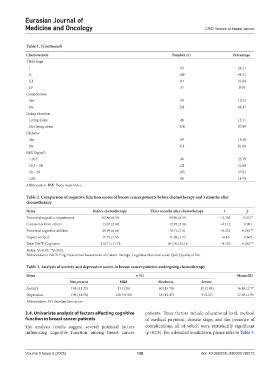
            Table 1. (Continued)
            Characteristic                                                Number (n)                Percentage
            TNM stage
             I                                                                92                      24.21
             II                                                              168                      44.21
             III                                                              83                      21.84
             IV                                                               37                       9.74
            Complication
             Yes                                                              59                      15.53
             No                                                              321                      84.47
            Living situation
             Living alone                                                     46                      12.11
             Not living alone                                                334                      87.89
            Diabetes
             Yes                                                              69                      18.16
             No                                                              311                      81.84
            BMI (kg/m )
                   2
             <18.5                                                            98                      25.79
             18.5 – 24                                                       121                      31.84
             24 – 28                                                         105                      27.63
             ≥28                                                              56                      14.74
            Abbreviation: BMI: Body mass index.


            Table 2. Comparison of cognitive function scores of breast cancer patients before chemotherapy and 3 months after
            chemotherapy
            Items                        Before chemotherapy     Three months after chemotherapy  t       p
            Perceived cognitive impairment  62.86±8.18                   58.89±8.19            −2.365   0.014*
            Comments from others            13.07±2.08                   12.95±2.10            −0.112    0.901
            Perceived cognitive abilities   26.95±6.66                   18.71±7.01            −8.235   0.001**
            Impact on QoL                   11.79±1.85                   11.68±1.74            −0.16     0.863
            Total FACT-Cog score            116.71±11.78                104.76±22.18           −4.376   0.001**
            Notes: *p<0.05, **p<0.01.
            Abbreviations: FACT-Cog: Functional Assessment of Cancer Therapy-Cognitive Function scale; QoL: Quality of life.

            Table 3. Analysis of anxiety and depression scores in breast cancer patients undergoing chemotherapy
            Items                                          n (%)                                      Mean±SD
                               Not present          Mild            Moderate           Severe
            Anxiety            195 (51.32)         114 (30)          60 (15.79)       11 (2.89)       16.18±3.77
            Depression         196 (51.58)        120 (31.58)        55 (14.47)        9 (2.37)       17.39±3.95
            Abbreviation: SD: Standard deviation.

            3.4. Univariate analysis of factors affecting cognitive   patients. These factors include educational level, method
            function in breast cancer patients                 of  medical  payment, disease  stage,  and the  presence of
            The analysis results suggest several potential factors   complications, all of which were statistically significant
            influencing  cognitive  function  among  breast  cancer   (p<0.05). For a detailed breakdown, please refer to Table 5.


            Volume 9 Issue 3 (2025)                        138                         doi: 10.36922/EJMO025130073

