


Page 147 - EJMO-9-3
P. 147
Eurasian Journal of
            Medicine and Oncology                                                       CRCI factors in breast cancer


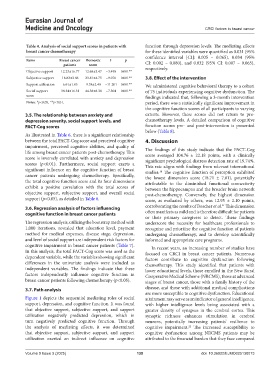
            Table 4. Analysis of social support scores in patients with   function through depression levels. The mediating effects
            breast cancer chemotherapy                         for these identified variables were quantified as 0.031 (95%
                                                               confidence interval [CI]: 0.005 – 0.065), 0.034  (95%
            Items         Breast cancer   Domestic   t  p
                            patients   norm                    CI: 0.002 – 0.080), and 0.032  (95% CI: 0.007 – 0.065),
            Objective support  12.23±16.77  12.68±3.47  −3.498  0.001**  respectively.
            Subjective support  18.82±3.86  23.81±4.75  −9.076  0.001**  3.8. Effect of the intervention
            Support utilization  6.61±1.05  9.38±2.40  −11.201 0.001**  We administered cognitive behavioral therapy to a cohort
            Social support   38.34±16.31  44.38±8.38  −7.304  0.001**  of 75 individuals experiencing cognitive dysfunction. The
            score                                              findings indicated that, following a 3-month intervention
            Notes: *p<0.05, **p<0.01.                          period, there was a statistically significant improvement in
                                                               the cognitive function scores of all participants to varying
            3.5. The relationship between anxiety and          extents. However, these scores did not return to pre-
            depression severity, social support levels, and    chemotherapy levels. A detailed comparison of cognitive
            FACT-Cog scores                                    function scores pre-  and post-intervention is presented
                                                               below (Table 8).
            As illustrated in Table 6, there is a significant relationship
            between the total FACT-Cog score and perceived cognitive   4. Discussion
            impairment, perceived cognitive abilities, and quality of   The findings of this study indicate that the FACT-Cog
            life among breast cancer patients post-chemotherapy. This   score averaged 104.76 ± 22.18 points, with a clinically
            score is inversely correlated with anxiety and depression   significant psychological distress detection rate of 19.74%.
            scores (p<0.01). Furthermore, social support exerts a   This rate aligns with findings from relevant international
            significant influence on the cognitive function of breast   studies.  The cognitive function of perception exhibited
                                                                     14
            cancer patients undergoing chemotherapy. Specifically,   the lowest dimension score (18.71 ± 7.01), potentially
            the total cognitive function score and its four dimensions   attributable  to  the  diminished  functional  connectivity
            exhibit a positive correlation with the total scores of   between the hippocampus and the broader brain network
            objective support, subjective support, and overall social   post-chemotherapy. Conversely, the  highest dimension
            support (p<0.05), as detailed in Table 6.          score, as  evaluated by others, was 12.95  ± 2.10  points,
                                                                                               21
            3.6. Regression analysis of factors influencing    corroborating the results of Boscher et al.  This dimension
            cognitive function in breast cancer patients       often manifests as mild and is therefore difficult for patients
                                                               or their primary caregivers to detect. These findings
            The regression analysis, utilizing the bootstrap method with   underscore the necessity for healthcare professionals to
            1,000 iterations, revealed that education level, payment   recognize and prioritize the cognitive function of patients
            method for medical expenses, disease stage, depression,   undergoing chemotherapy, and to develop scientifically
            and level of social support are independent risk factors for   informed and appropriate care programs.
            cognitive impairment in breast cancer patients (Table 7).   In recent years, an increasing number of studies have
            In this analysis, the total FACT-Cog score was used as the   focused on CRCI in breast cancer patients. Numerous
            dependent variable, while the variables showing significant   factors contribute to cognitive dysfunction following
            differences in the univariate analysis were included as   chemotherapy. This study identified that patients with
            independent variables. The findings indicate that these   lower educational levels, those enrolled in the New Rural
            factors  independently  influence  cognitive  function  in   Cooperative Medical Scheme (NRCMS), those at advanced
            breast cancer patients following chemotherapy (p<0.05).  stages of breast cancer, those with a family history of the
            3.7. Path analysis                                 disease, and those with additional medical complications
                                                               are more susceptible to cognitive dysfunction. Educational
            Figure 1 depicts the sequential mediating roles of social   attainment may serve as an indicator of general intelligence,
            support, depression, and cognitive function. It was found   with higher intelligence levels being associated with a
            that objective support, subjective support, and support   greater density of synapses in the cerebral cortex. This
            utilization negatively predicted depression, which in   synaptic  richness  enhances  stimulation  in  cerebral
            turn negatively predicted cognitive function. Through   neurons, potentially increasing patients’ resilience to
            the analysis of mediating effects, it was determined   cognitive impairment.  The increased susceptibility to
                                                                                 22
            that objective support, subjective support, and support   cognitive dysfunction among NRCMS patients may be
            utilization exerted  an  indirect influence  on cognitive   attributed to the financial burden that they face compared


            Volume 9 Issue 3 (2025)                        139                         doi: 10.36922/EJMO025130073

