


Page 261 - EJMO-9-3
P. 261
Eurasian Journal of
            Medicine and Oncology                                          Metastasis gene expression in colorectal cancer


            significant upregulation of SNAI1, Slug, ZEB1, Twist,   urea nitrogen, creatinine, systolic blood pressure, diastolic
            and TNF-α in the liver metastasis group, as compared to   blood pressure, and age. However, individuals with liver
            both  non-liver  metastasis  patients  and adjacent normal   metastases from CRC exhibited higher levels of circulating
            tissue, underscores the central roles of these transcription   fasting blood glucose, albumin, platelets, and blood urea
            factors and inflammatory mediators in facilitating   nitrogen. Notably, CEA, ALT, AST, and BMI showed
            metastatic dissemination. This pattern of expression   significant differences between the groups (p<0.05) as
            aligns with the well-established understanding that EMT   detailed in Table 2.
            is a pivotal driver in cancer metastasis, endowing tumor   It was observed that SNAI1, Slug, ZEB1, Twist, and
            cells with enhanced migratory and invasive properties.   TNF-α were most highly expressed in the liver metastasis
            The concurrent downregulation of MTA3 in the liver   group, whereas MTA3 was markedly decreased in this
            metastasis group is particularly noteworthy, as it suggests   group (Figure 1). The expression levels were significantly
            a loss of EMT suppression, further promoting a pro-  different when compared to both the non-liver metastasis
            metastatic phenotype. The following presents a structured   group and adjacent normal tissue. Further analysis using
            framework based on mechanistic insights supported by   univariate linear regression revealed that SNAI1, ZEB1,
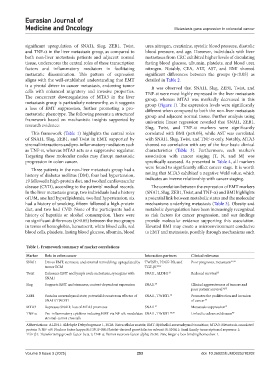
            research evidence:
                                                               Slug, Twist, and TNF-α markers were significantly
              This framework (Table 1) highlights the central roles   correlated with BMI (p≤0.05), while AST was correlated
            of SNAI1, Slug, ZEB1, and Twist in EMT, supported by   with SNAI1, Slug, Twist, and TNF-α only. Notably, MTA3
            stromal interactions and pro-inflammatory mediators such   showed no correlation with any of the four basic clinical
            as TNF-α, whereas MTA3 acts as a suppressive regulator.   characteristics (Table  3). Furthermore, each marker’s
            Targeting these molecular nodes may disrupt metastatic   association with cancer staging (T, N, and M) was
            progression in colon cancer.                       specifically assessed. As presented in Table 4, all markers
              Three patients in the non-liver metastasis group had a   were found to significantly affect cancer stage. It is worth
            history of diabetes mellitus (DM), four had hypertension,   noting that MTA3 exhibited a negative Wald value, which
            19 followed a high-protein diet, and two had cardiovascular   indicates an inverse relationship with cancer staging.
            disease (CVD), according to the patients’ medical records.   The correlation between the expression of EMT markers
            In the liver metastasis group, two individuals had a history   (SNAI1, Slug, ZEB1, Twist, and TNF-α) and BMI highlights
            of DM, one had hyperlipidemia, two had hypertension, six   a potential link between metabolic status and the molecular
            had a history of smoking, fifteen followed a high-protein   mechanisms underlying metastasis (Table 3). Obesity and
            diet, and two had CVD. None of the participants had a   metabolic dysregulation have been increasingly recognized
            history of hepatitis or alcohol consumption. There were   as risk factors for cancer progression, and our findings
            no significant differences (p≥0.05) between the two groups   provide molecular evidence supporting this association.
            in terms of hemoglobin, hematocrit, white blood cells, red   Elevated BMI may create a microenvironment conducive
            blood cells, platelets, fasting blood glucose, albumin, blood   to EMT and metastasis, possibly through mechanisms such


            Table 1. Framework summary of marker correlations
            Marker  Role in colon cancer                       Interaction partners  Clinical relevance
            SNAI1   Drives EMT, stemness, and stromal remodeling; upregulated by  TWIST1, PDGF-BB, and   Poor prognosis, metastasis 31,32
                    tumor ECM                                  TGF-β1 30,31
            Twist   Enhances EMT and lymph node metastasis; synergizes with   SNAI1, ALDH1 33  Reduced survival 33
                    SNAI1
            Slug    Supports EMT and stemness; context-dependent expression  SNAI1 34  Clinical aggressiveness of tumors and
                                                                                  poor patient survival 34,35
            ZEB1    Sustains mesenchymal state; potential downstream effector of   SNAI1, TWIST1 36  Promotes the proliferation and invasion
                    SNAI1/TWIST1                                                  of cancer 37
            MTA3    Represses SNAI1; loss of MTA3 promotes     SNAI1 31           Metastasis suppression 31
            TNF-α   Pro-inflammatory cytokine inducing EMT via NF-κB; modulates  SNAI1, TWIST1 38,39  Linked to advanced disease 40
                    stromal-tumor crosstalk
            Abbreviations: ALDH1: Aldehyde Dehydrogenase 1, ECM: Extracellular matrix; EMT: Epithelial-mesenchymal transition; MTA3: Metastasis-associated
            protein 3; NF- κB: Nuclear factor kappa B; PDGF-BB; Platelet-derived growth factor subunit B; SNAI1: Snail family transcriptional repressor 1;
            TGF-β1: Transforming growth factor-beta 1; TNF-α: Tumor necrosis factor-alpha; ZEB1: Zinc finger e-box binding homeobox 1.


            Volume 9 Issue 3 (2025)                        253                         doi: 10.36922/EJMO025210202

