


Page 263 - EJMO-9-3
P. 263
Eurasian Journal of
            Medicine and Oncology                                          Metastasis gene expression in colorectal cancer


               A                                               Table 4. Ordinal regression analysis
                                                               Response      Predictor     Wald value  p‑value
                                                               Stage (TNM)   SNAI1           3.006     0.022*
                                                               Stage (TNM)   ZEB1            1.725     0.031*
                                                               Stage (TNM)   Slug            2.018     0.016*
                                                               Stage (TNM)   Twist           1.922     0.028*
               B                                               Stage (TNM)   MTA3           −3.443     0.035*
                                                               Stage (TNM)   TNF-α           5.813     0.006*
                                                               Note: * Significant with p≤0.05.
                                                               Abbreviations: M: Metastasis; MTA3: Metastasis-associated protein 3;
                                                               N: Node; SNAI1: Snail family transcriptional repressor 1; T: Tumor;
                                                               TNF-α: Tumor necrosis factor-alpha; ZEB1: Zinc finger e-box binding
                                                               homeobox 1.
               C
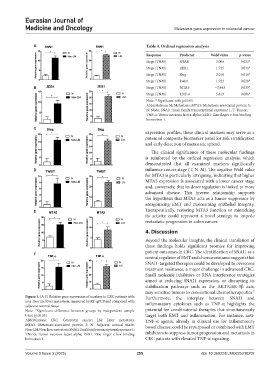
                                                               expression profiles, these clinical markers may serve as a
                                                               potential composite biomarker panel for risk stratification
                                                               and early detection of metastatic spread.

                                                                 The clinical  significance  of these molecular findings
                                                               is reinforced by the ordinal regression analysis, which
                                                               demonstrated that all examined markers significantly
               D                                               influence cancer stage (T, N, M). The negative Wald value
                                                               for MTA3 is particularly intriguing, indicating that higher
                                                               MTA3 expression is associated with a lower cancer stage
                                                               and, conversely, that its downregulation is linked to more
                                                               advanced disease. This inverse relationship supports
                                                               the hypothesis that MTA3 acts as a tumor suppressor by
                                                               antagonizing EMT and maintaining epithelial integrity.

               E                                               Therapeutically, restoring MTA3 function or mimicking
                                                               its activity could represent a novel strategy to impede
                                                               metastatic progression in colon cancer.

                                                               4. Discussion
                                                               Beyond the molecular insights, the clinical translation of
                                                               these findings holds significant promise for improving
                                                               patient outcomes in CRC. The identification of SNAI1 as a
               F
                                                               central regulator of EMT and chemoresistance suggests that
                                                               SNAI1-targeted therapies could be developed to overcome
                                                               treatment resistance, a major challenge in advanced CRC.
                                                               Small molecule inhibitors or RNA interference strategies
                                                               aimed at reducing SNAI1 expression, or disrupting its
                                                               stabilization pathways  such as  the AKT/GSK-3β axis,
                                                                                                             7
                                                               may sensitize tumors to conventional chemotherapeutics.
            Figure 1. (A-F) Relative gene expression of markers in CRC patients with   Furthermore, the interplay between SNAI1 and
            non-liver and liver metastasis, measured by RT-qPCR and compared with   inflammatory cytokines such as TNF-α highlights the
            adjacent normal tissue
            Note: *Significant difference between groups by independent sample   potential for combinatorial therapies that simultaneously
            t-test (p≤0.05).                                   target both  EMT and inflammation. For  instance, anti-
            Abbreviations: CRC: Colorectal cancer; LM: Liver metastasis;   TNF-α agents, already in clinical use for inflammatory
            MTA3: Metastasis-associated protein 3; N: Adjacent normal tissue;   bowel disease, could be repurposed or combined with EMT
            Non-LM: Non-liver metastasis; SNAI1: Snail family transcriptional repressor 1;
            TNF-α: Tumor necrosis factor-alpha; ZEB1: Zinc finger e-box binding   inhibitors to suppress tumor progression and metastasis in
            homeobox 1.                                        CRC patients with elevated TNF-α signaling.


            Volume 9 Issue 3 (2025)                        255                         doi: 10.36922/EJMO025210202

