


Page 87 - EJMO-9-3
P. 87
Eurasian Journal of
            Medicine and Oncology                                          Mapping breast cancer PPI networks for targets


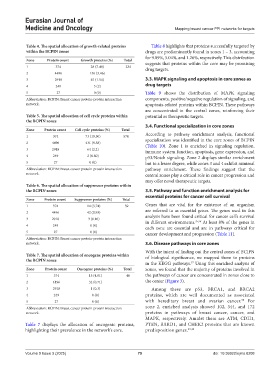
            Table 4. The spatial allocation of growth‑related proteins   Table 8 highlights that proteins successfully targeted by
            within the BCPIN zones                             drugs are predominantly found in zones 1 – 3, accounting
                                                               for 9.09%, 5.04%, and 1.26%, respectively. This distribution
            Zone     Protein count  Growth proteins (%)  Total  suggests that proteins within the core may be promising
            1            374            28 (7.48)     234      drug targets.
            2           4496           156 (3.46)
            3           2918            45 (1.54)              3.3. MAPK signaling and apoptosis in core zones as
            4            249             5 (2)                 drug targets
            5            27              0 (0)                 Table  9  shows  the  distribution  of  MAPK  signaling
            Abbreviation: BCPIN: Breast cancer protein-protein interaction   components, positive/negative regulation of signaling, and
            network.                                           apoptosis-related proteins within BCPIN. These pathways
                                                               are concentrated in the central zones, reinforcing their
            Table 5. The spatial allocation of cell cycle proteins within   potential as therapeutic targets.
            the BCPIN zones
                                                               3.4. Functional specialization in core zones
            Zone    Protein count  Cell cycle proteins (%)  Total
                                                               According to pathway enrichment analysis, functional
            1           374          73 (19.50)      570
            2          4496          431 (9.58)                specialization was identified in the core zones of BCPIN
                                                               (Table  10). Zone 1 is enriched in signaling regulation,
            3          2918           64 (2.2)                 immune system function, apoptosis, gene expression, and
            4           249           2 (0.80)                 p53/Notch signaling. Zone 2 displays similar enrichment
            5           27             0 (0)                   but to a lesser degree, while zones 3 and 4 exhibit minimal
            Abbreviation: BCPIN: Breast cancer protein-protein interaction   pathway  enrichment. These  findings  suggest  that  the
            network.                                           central zones play a critical role in cancer progression and
                                                               may offer novel therapeutic targets.
            Table 6. The spatial allocation of suppressor proteins within
            the BCPIN zones                                    3.5. Pathway and function enrichment analysis for
                                                               essential proteins for cancer cell survival
            Zone    Protein count  Suppressor proteins (%)  Total
            1           374           14 (3.74)       59       Genes that are vital for the existence of an organism
            2          4496           42 (0.93)                are referred to as essential genes. The genes used in this
            3          2918           3 (0.10)                 analysis have been found critical for cancer cell’s survival
                                                               in different environments. 35,36  At least 8% of the genes in
            4           249            0 (0)                   each zone are essential and are in pathways critical for
            5           27             0 (0)                   cancer development and progression (Table 11).
            Abbreviation: BCPIN: Breast cancer protein-protein interaction
            network.                                           3.6. Disease pathways in core zones
                                                               With the intent of finding out the central zones of BCIPN
            Table 7. The spatial allocation of oncogene proteins within
            the BCPIN zones                                    of biological significance, we mapped them to proteins
                                                               in the KEGG pathways.  Using this enriched analysis of
                                                                                  37
            Zone    Protein count  Oncogene proteins (%)  Total  zones, we found that the majority of proteins involved in
            1           374            15 (4.01)       48      the pathways of cancer are concentrated in zones close to
            2          4496            32 (0.71)               the center (Figure 3).
            3          2918             1 (0.3)                  Among these are p53, BRCA1, and BRCA2
            4           249             0 (0)                  proteins, which are well documented as associated
                                                                                                        38
            5           27              0 (0)                  with hereditary breast and ovarian cancer.  For
            Abbreviation: BCPIN: Breast cancer protein-protein interaction   zone 2, enriched analysis showed 102, 344, and 172
            network.                                           proteins in pathways of breast cancer, cancer, and
                                                               MAPK, respectively. Amidst them are ATM, CDH1,
            Table  7 displays the allocation of oncogenic proteins,   PTEN, BARD1, and CHEK2 proteins that are known
            highlighting their prevalence in the network’s core.  predisposition genes. 39,40


            Volume 9 Issue 3 (2025)                         79                              doi: 10.36922/ejmo.8208

