


Page 89 - EJMO-9-3
P. 89
Eurasian Journal of
            Medicine and Oncology                                          Mapping breast cancer PPI networks for targets


            Table 11. Summary of the KEGG enriched pathways for essential proteins and their pathways for cancer
            Zone      Essential genes in zone (%)  KEGG enriched pathways
            Center            1 (100)
            1                38 (10.16)        Cell cycle, JAK-STAT pathway, WNT pathway, p53 pathway, FoxO pathway, MAPK pathway,
                                               TGF-β pathway, focal adhesion, cAMP signaling pathway, sphingolipid signaling pathway, Ras
                                               signaling pathway
            2               506 (11.26)        Proteasome, spliceosome, DNA replication, cell cycle, nucleotide excision repair, mRNA
                                               surveillance pathway, ubiquitin-mediated proteolysis, mismatch repair
            3                256 (8.77)        Proteasome, spliceosome, nucleocytoplasmic transport, protein export, mRNA surveillance
                                               pathways, ribosome biogenesis in eukaryotes, oxidative phosphorylation
            4                37 (14.86)        RNA degradation
            5                4 (14.86)         Citrate cycle, carbon metabolism, metabolic pathways
            Note: Significantly enriched pathways at adjusted p<0.05.
            Abbreviation: Kyoto encyclopedia of genes and genomes.


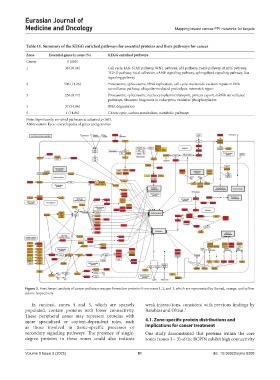
            Figure 3. Enrichment analysis of cancer pathways was performed on proteins from zones 1, 2, and 3, which are represented by the red, orange, and yellow
            colors, respectively

              In contrast, zones 4 and 5, which are sparsely   weak interactions, consistent with previous findings by
            populated,  contain  proteins  with  lower  connectivity.   Barabási and Oltvai. 3
            These peripheral zones may represent proteins with
            more specialized or context-dependent roles, such   4.1. Zone-specific protein distributions and
            as those involved in tissue-specific processes or   implications for cancer treatment
            secondary signaling pathways. The presence of single-  Our study demonstrated that proteins within the core
            degree proteins in these zones could also indicate   zones (zones 1 – 3) of the BCPIN exhibit high connectivity


            Volume 9 Issue 3 (2025)                         81                              doi: 10.36922/ejmo.8208

