


Page 88 - EJMO-9-3
P. 88
Eurasian Journal of
            Medicine and Oncology                                          Mapping breast cancer PPI networks for targets


            4. Discussion                                      pathways,  including  signal  transduction,  apoptosis,  and
                                                               cellular stress responses. 41,42
            This study highlights the biological significance of BCPIN
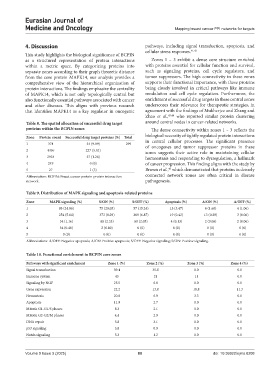
            as a structured representation of protein interactions   Zones 1 – 3 exhibit a dense core structure enriched
            within a metric space. By categorizing proteins into   with proteins essential for cellular function and survival,
            separate zones according to their graph theoretic distance   such as signaling proteins, cell cycle regulators, and
            from the core protein MAPK14, our analysis provides a   tumor suppressors. The high connectivity in these zones
            comprehensive view of the hierarchical organization of   supports their functional importance, with these proteins
            protein interactions. The findings emphasize the centrality   being closely involved in critical pathways like immune
            of MAPK14, which is not only topologically central but   modulation and cell cycle regulation. Furthermore, the
            also functionally essential pathways associated with cancer   enrichment of successful drug targets in these central zones
            and other diseases. This aligns with previous research   underscores their relevance for therapeutic strategies, in
            that identifies MAPK14 as a key regulator in oncogenic   agreement with the findings of Mukherjee and Zhang and
                                                               Zhao  et al., 43,44  who reported similar protein clustering
            Table 8. The spatial allocation of successful drug target   around central nodes in cancer-related networks.
            proteins within the BCPIN zones                      The dense connectivity within zones 1 – 3 reflects the

            Zone  Protein count  Successful drug target proteins (%)  Total  biological necessity of tightly regulated protein interactions
            1        374              34 (9.09)        299     in central cellular processes. The significant presence
                                                               of oncogenes and tumor suppressor proteins in these
            2        4496            227 (5.01)                zones  suggests  their  active  role  in  maintaining  cellular
            3        2918             37 (1.26)                homeostasis and responding to dysregulation, a hallmark
            4        249               0 (0)                   of cancer progression. This finding aligns with the study by
                                                                         45
            5         27               1 (3)                   Brown et al.,  which demonstrated that proteins in densely
            Abbreviation: BCPIN: Breast cancer protein-protein interaction   connected network zones are often critical in disease
            network.                                           pathogenesis.
            Table 9. Distribution of MAPK signaling and apoptosis‑related proteins

            Zone      MAPK signaling (%)   S/ON (%)      S/OFF (%)     Apoptosis (%)   A/ON (%)     A/OFF (%)
            1             93 (24.86)       75 (20.05)     57 (15.24)     13 (3.47)      6 (1.60)      4 (1.06)
            2             254 (5.64)       373 (8.29)     309 (6.87)     19 (0.42)      13 (0.28)     3 (0.06)
            3             34 (1.16)         68 (2.33)     60 (2.05)       4 (0.13)      2 (0.06)      2 (0.06)
            4             34 (0.40)         2 (0.80)       0 (0)           0 (0)         0 (0)         0 (0)
            5               0 (0)            0 (0)         0 (0)           0 (0)         0 (0)         0 (0)
            Abbreviations: A/OFF: Negative apoptosis; A/ON: Positive apoptosis; S/OFF: Negative signaling; S/ON: Positive signaling.


            Table 10. Functional enrichment in BCPIN core zones
            Pathways with significant enrichment  Zone 1 (%)   Zone 2 (%)        Zone 3 (%)        Zone 4 (%)
            Signal transduction                  59.4             35.8              0.0               0.0
            Immune system                         45              21                11                0.0
            Signaling by NGF                     25.5             6.8               0.0               0.0
            Gene expression                      22.2             13.8             18.8               11.3
            Hemostasis                           20.8             6.9               3.3               0.0
            Apoptosis                            11.9             2.7               0.0               0.0
            Mitotic G1-G1/S phases                8.3             2.1               0.0               0.0
            Mitotic G2-G2/M phases                4.4             2.9               0.0               0.0
            DNA repair                            5.8             3.1               0.0               0.0
            p53 signaling                         5.8             0.9               0.0               0.0
            Notch signaling                       3.3             1.2               0.0               0.0


            Volume 9 Issue 3 (2025)                         80                              doi: 10.36922/ejmo.8208

