


Page 82 - ESAM-1-1
P. 82
Engineering Science in
            Additive Manufacturing                                                       ML in additive manufacturing


            which are often challenging to implement in practical   asset (i.e., data and model), thus requiring expertise from
            production settings. Therefore, this paper proposes and   both AM and AI domains. A recent study indicated that
            formulates industrial deployability, underpinning the crucial   reproducibility in this domain is unsatisfactory due to
            characteristics  of AI-driven AM systems  for real-world   missing information in the literature, especially for data and
            deployments. Industrial deployability encompasses seven   model information.  Therefore, researchers must develop
                                                                              147
            key elements: cost-efficiency, reproducibility, reusability,   frameworks that organize AI-driven AM knowledge and
            data privacy and safety, compliance with standards,   guide reproduction. For example, Xie et al.  proposed a
                                                                                                  147
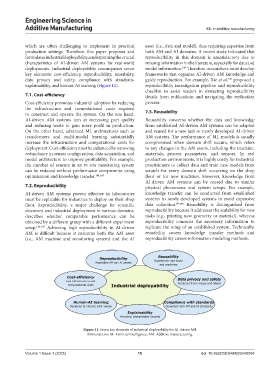
            explainability, and human-AI teaming (Figure 11).  reproducibility investigation pipeline and reproducibility
                                                               checklist to assist readers in extracting reproducibility
            7.1. Cost-efficiency                               details from publications and navigating the replication
            Cost-efficiency promotes industrial adoption by reducing   process.
            the infrastructure and computational costs required
            to construct and operate the system. On the one hand,   7.3. Reusability
            AI-driven AM systems aim at increasing part quality   Reusability concerns whether the data and knowledge
            and reducing waste to gain more profit in production.   from established AI-driven AM systems can be adapted
            On the other hand, advanced ML architectures such as   and reused for a new task or newly developed AI-driven
            transformers and multi-modal  learning substantially   AM systems. The performance of ML models is usually
            increase the infrastructure and computational costs for   compromised when domain shift occurs, which refers
            deployment. Cost-efficiency must be enhanced by removing   to any changes in the AM assets, including the machine,
            redundancy in sensor configuration, data acquisition, and   materials, process parameters, and sensors. In real
            model architecture to improve profitability. For example,   production environments, it is highly costly for industrial
            the number of sensors in an  in situ monitoring system   practitioners to collect data and train new models from
            can be reduced without performance compromise using   scratch for every domain shift occurring on the shop
            optimization and knowledge transfer. 144,145       floor or for new machines. However, knowledge from
                                                               AI-driven AM systems can be reused due to similar
            7.2. Reproducibility                               physical phenomena and system setups. For example,
            AI-driven AM systems proven effective in laboratories   knowledge transfer can be conducted from established
            must be replicable for industries to deploy on their shop   systems to newly developed systems to avoid expensive
            floor. Reproducibility, a major challenge for scientific   data collection. 89,148  Reusability is distinguished from
            discovery and industrial deployment in various domains,   reproducibility because it addresses the scalability for new
            describes whether comparable performance can be    tasks (e.g., printing new geometry or material), whereas
            obtained by a different group with a different experiment   reproducibility concerns the necessary information to
            setup. 146,147  Achieving high reproducibility in AI-driven   replicate the setup of an established system. Technically,
            AM is difficult because it concerns both the AM asset   reusability covers knowledge transfer methods and
            (i.e., AM machine and monitoring system) and the AI   reproducibility covers information modeling methods.


                                     Figure 11. Seven key elements of industrial deployability for AI-driven AM
                                      Abbreviations: AI: Artificial intelligence; AM: Additive manufacturing.


            Volume 1 Issue 1 (2025)                         15                         doi: 10.36922/ESAM025040004

