


Page 81 - ESAM-1-1
P. 81
Engineering Science in
            Additive Manufacturing                                                       ML in additive manufacturing


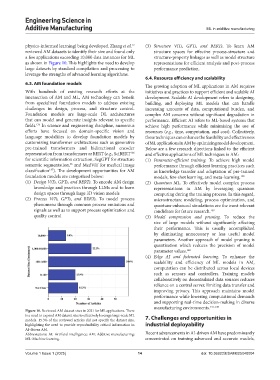
            physics-informed learning) being developed. Zhang et al.    (3)  Structure ViTs, GPTs, and BERTs. To learn AM
                                                         12
            reviewed AM datasets to identify their size and found only   structure  spaces  for  effective  process-structure  and
            a few applications exceeding 10,000 data instances for ML   structure-property linkages as well as model structure
            as shown in Figure 10. This highlights the need to develop   representations for efficient analysis and post-process
            large datasets by standard compilation and processing to   performance prediction.
            leverage the strengths of advanced learning algorithms.
                                                               6.4. Resource efficiency and scalability
            6.3. AM foundation models                          The growing adoption of ML applications in AM requires

            With hundreds of existing research efforts at the   initiatives and practices to support efficient and scalable AI
            intersection of AM and ML, AM technology can benefit   development. Scalable AI development refers to designing,
            from specialized foundation models to address existing   building, and deploying ML models that can handle
            challenges in design, process, and structure control.   increasing amounts of data, computational burden, and
            Foundation models are large-scale DL architectures   complex AM concerns without significant degradation in
            that can model and generate insights relevant to specific   performance. Efficient AI refers to ML-based systems that
            fields.  In science and engineering discipline, numerous   achieve high performance while minimizing the use of
                135
            efforts  have  focused  on  domain-specific  vision and   resources (e.g., time, computation, and cost). Collectively,
            language  modalities  to develop  foundation models  by   these techniques can enhance the feasibility and effectiveness
            customizing transformer architectures such as generative   of ML applications in AM by optimizing model development.
            pre-trained transformers and bidirectional encoder   Below are a few research directions linked to the efficient
            representation from transformers or BERT (e.g., SciBERT    and effective applications of ML techniques in AM:
                                                         136
            for scientific information extraction, SegGPT for structure   (1)  Parameter-efficient training. To achieve high model
            semantic segmentation,  and MedViT for medical image   performance through efficient learning practices such
                               85
            classification ). The development opportunities for AM   as knowledge transfer and adaptation of pre-trained
                      137
            foundation models are categorized below:              models, few-shot learning, and meta-learning. 138
            (1)  Design ViTs, GPTs, and BERTs. To encode AM design   (2)  Quantum ML. To effectively model complex process
               knowledge and practices through LLMs and to learn   representations in AM by leveraging quantum
               design spaces through large 3D vision models       computing during the training process. In this regard,
            (2)  Process ViTs, GPTs, and BERTs. To model process   microstructure modeling, process optimization, and
               phenomena through common process emissions and     quantum-enhanced simulations are the most relevant
               signals as well as to support process optimization and   candidates for future research. 139
               quality control                                 (3)  Model compression and pruning.  To  reduce  the
                                                                  size  of large models  without  significantly  affecting
                                                                  their performance. This is usually accomplished
                                                                  by eliminating unnecessary or less useful model
                                                                  parameters. Another approach of model pruning is
                                                                  quantization which reduces the precision of model
                                                                  parameter values. 140
                                                               (4)  Edge AI and federated learning. To enhance the
                                                                  scalability and efficiency of ML models in AM,
                                                                  computation can  be distributed across  local  devices
                                                                  such as sensors and controllers. Training models
                                                                  collaboratively on decentralized data sources reduces
                                                                  reliance on a central server, limiting data transfer and
                                                                  improving privacy. This approach maintains model
                                                                  performance while lowering computational demands
                                                                  and supporting real-time decision-making in diverse
                                                                  manufacturing environments. 141-143
            Figure 10. Reviewed AM dataset sizes in 2021 for ML applications. There
            is a need to expand AM dataset size to effectively leverage large-scale ML   7. Challenges and opportunities in
            models. 15.3% of the reviewed articles did not specify the dataset size,
            highlighting the need to provide reproducibility critical information in   industrial deployability
            AI-driven AM.
            Abbreviations: AI: Artificial intelligence; AM: Additive manufacturing;   Recent advancements in AI-driven AM have predominantly
            ML: Machine learning.                              concentrated on training advanced and accurate models,


            Volume 1 Issue 1 (2025)                         14                         doi: 10.36922/ESAM025040004

