


Page 80 - ESAM-1-1
P. 80
Engineering Science in
            Additive Manufacturing                                                       ML in additive manufacturing


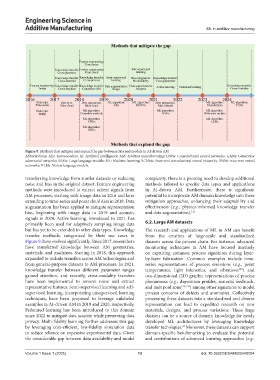
            Figure 9. Methods that mitigate and expand the gap between data and models in AI-driven AM
            Abbreviations: AEs: Autoencoders; AI: Artificial intelligence; AM: Additive manufacturing; CNNs: Convolutional neural networks; GANs: Generative
            adversarial networks; LLMs: Large language models; ML: Machine learning; RCNNs: Recurrent convolutional neural networks; RNNs: recurrent neural
            networks; VLMs: Vision-language models.

            transferring knowledge from similar datasets or reducing   complexity, there is a pressing need to develop additional
            noise and bias in the original dataset. Feature engineering   methods tailored to specific data types and applications
            methods were introduced to extract salient signals from   in AI-driven AM. Furthermore, there is significant
            AM processes, starting with image data in 2016 and later   potential to incorporate AM domain knowledge into these
            extending to time-series and point cloud data in 2018. Data   mitigation  approaches,  enhancing  their  adaptability  and
            augmentation has been applied to mitigate representation   effectiveness (e.g., physics-informed knowledge transfer
            bias, beginning with image data in 2019 and acoustic   and data augmentation). 131
            signals in 2020. Active learning, introduced in 2021, has
            primarily  been  used  for  adaptively  sampling  image  data   6.2. Large AM datasets
            but has yet to be extended to other data types. Knowledge   The research and applications of ML in AM can benefit
            transfer methods, categorized by their use cases in   from the creation of large-scale and standardized
            Figure 9, have evolved significantly. Since 2017, researchers   datasets across the process chain. For instance, advanced
            have  transferred  knowledge  between  AM  geometries,   monitoring techniques in AM have focused intensely
            materials, and machines. Starting in 2018, this approach   on capturing  common  process  signatures  during  layer-
            expanded to include transfers across AM technologies and   by-layer fabrication. Common examples include time-
            from general-purpose datasets to AM processes. In 2021,   series representations of process emissions (e.g., point
            knowledge transfer between different parameter ranges   temperatures, light intensities, and vibrations ) and
                                                                                                       132
            gained  attention,  and  recently,  cross-modality  transfers   two-dimensional (2D) graphic representations of process
            have been implemented to remove noise and extract   phenomena  (e.g.,  deposition  profiles,  material  feedstock,
            representative features. Semi-supervised learning and self-  and melt pool zone 133,134 ) among other signatures to model
            supervised learning, incorporating unsupervised learning   process concerns of defects and anomalies. Collectively
            techniques, have been proposed to leverage unlabeled   processing these datasets into a standardized and diverse
            examples in AI-driven AM in 2019 and 2020, respectively.   representation can lead to expedited research on new
            Federated  learning  has  been  introduced  to  this  domain   materials, designs, and process variations. These large
            since 2022 to mitigate data scarcity while preserving data   datasets can be a source of domain knowledge for newly
            privacy. Multi-fidelity learning further addresses this gap   developed ML architectures by leveraging knowledge
                                                                               89
            by leveraging cost-efficient, low-fidelity simulation data   transfer techniques.  Moreover, these datasets can support
            to reduce reliance on expensive experimental data. Given   domain-specific benchmarking to evaluate the potential
            the considerable gap between data availability and model   and contributions of advanced learning approaches (e.g.,


            Volume 1 Issue 1 (2025)                         13                         doi: 10.36922/ESAM025040004

