


Page 75 - ESAM-1-1
P. 75
Engineering Science in
            Additive Manufacturing                                                       ML in additive manufacturing


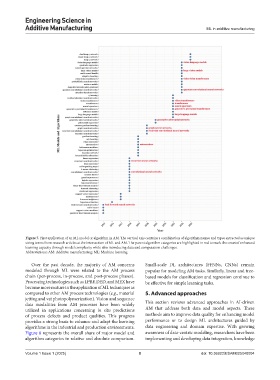
            Figure 7. First application of an ML model or algorithm in AM. The vertical axis contains a combination of algorithm names and types extracted as unique
            string terms from research articles at the intersection of ML and AM. The parent algorithm categories are highlighted in red to mark the onset of enhanced
            learning capacity through model complexity while also introducing data and computation challenges.
            Abbreviations: AM: Additive manufacturing; ML: Machine learning.


              Over the past decade, the majority of AM concerns   Small-scale DL architectures (FFNNs, CNNs) remain
            modeled through ML were related to the AM process   popular for modeling AM tasks. Similarly, linear and tree-
            chain (per-process, in-process, and post-process phases).   based models for classification and regression continue to
            Processing technologies such as LPBF, DED, and MEX have   be effective for simple learning tasks.
            become more mature in the application of ML techniques as
            compared to other AM process technologies (e.g., material   5. Advanced approaches
            jetting and vat photopolymerization). Vision and sequence
            data modalities from AM processes have been widely   This section reviews advanced approaches in AI-driven
            utilized in applications concerning  in situ predictions   AM that address both data and model aspects. These
            of process defects and product qualities. This progress   methods aim to improve data quality for enhancing model
            provides a strong basis to enhance and adapt the learning   performance or to design ML architectures guided by
            algorithms in the industrial and production environments.   data  engineering and domain  expertise.  With growing
            Figure 8 represents the overall share of major model and   awareness of data-centric modeling, researchers have been
            algorithm categories in relative and absolute comparison.   implementing and developing data integration, knowledge


            Volume 1 Issue 1 (2025)                         8                          doi: 10.36922/ESAM025040004

