


Page 70 - ESAM-1-1
P. 70
Engineering Science in
            Additive Manufacturing                                                       ML in additive manufacturing


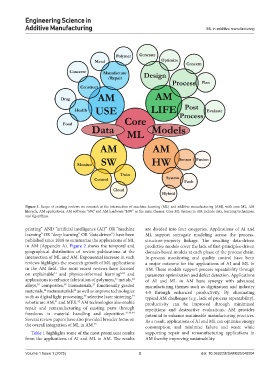
            Figure 1. Scope of existing reviews on research at the intersection of machine learning (ML) and additive manufacturing (AM), with core ML, AM
            lifecycle, AM applications, AM software “SW,” and AM hardware “HW” as the main themes. Core ML themes in AM include data, learning techniques,
            and algorithms.

            printing” AND “artificial intelligence (AI)” OR “machine   are  divided  into  four  categories.  Applications of AI  and
            learning” OR “deep learning” OR “data driven”) have been   ML support surrogate modeling across the process-
            published since 2018 to summarize the applications of ML   structure-property linkage. The resulting data-driven
            in AM (Appendix A). Figure 2 shows the temporal and   predictive models cover the lack of first-principles-driven
            geographical  distribution  of review publications at  the   domain-based models at each phase of the process chain.
            intersection of ML and AM. Exponential increase in such   In-process monitoring and quality control have been
            reviews highlights the research growth of ML applications   a  major  outcome  for  the  applications  of AI  and  ML  in
            in the AM field. The most recent reviews have focused   AM. These models support process repeatability through
            on explainable  and physics-informed learning  and   parameter optimization and defect detection. Applications
                        31
                                                    5,32
            applications to enhance fabrication of polymers,  metals,    of AI  and ML  in AM  have  synergy with advanced
                                                         34
                                                  33
            alloys,  composites,  biomaterials,  functionally graded   manufacturing themes such as digitization and industry
                                        37
                 35
                            36
            materials,  metamaterials  as well as improve technologies   4.0 through enhanced productivity. By eliminating
                                39
                    38
            such as digital light processing,  selective laser sintering,    typical AM challenges (e.g., lack of process repeatability),
                                                         24
                                     40
            robotic arc AM,  and MEX.  AM technologies also enable   productivity can be improved through minimized
                                  42
                        41
            repair and remanufacturing of existing parts through   repetitions  and  destructive  evaluations.  AM  provides
            freedoms in material handling and deposition. 41,43,44    potential to enhance sustainable manufacturing practices.
            Several review papers have also provided broader focus on   As a result, applications of AI and ML can optimize energy
            the overall integration of ML in AM. 45            consumption, and minimize failure and waste while
              Table 1 highlights some of the most prominent results   supporting  repair  and  remanufacturing  applications  in
            from the applications of AI and ML in AM. The results   AM thereby improving sustainability.
            Volume 1 Issue 1 (2025)                         3                          doi: 10.36922/ESAM025040004

