


Page 34 - ESAM-1-2
P. 34
Engineering Science in
            Additive Manufacturing                                          Multi-material additive manufacturing of metals


            1. Introduction                                                      A

            Metal additive manufacturing (AM) is revolutionizing
                                                         1,2
            industries with its growing adoption across automotive,
                  3-5
                              6-9
            nuclear,  aerospace,  energy, 10-12  and biomedical     F                          B
            sectors. 13-18  Utilizing a layer-by-layer approach guided
            by computer-aided design models,  metal AM offers
                                         19
            transformative advantages over traditional manufacturing
            methods, including reduced material waste, accelerated
            production  cycles,  enhanced  part  consolidation,  and
            unprecedented design flexibility. While significant strides   E                    C
            have been made in fabricating single-material components,
            the next frontier lies in further advancing multi-material
            (MM) metal AM (MMAM). Enhancing the quality,
            reliability, and performance of MM components is critical            D
            to unlocking their full potential and meeting the rigorous
            demands of real-world applications—a challenge this
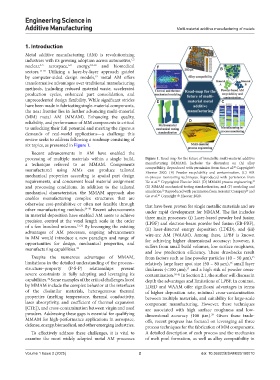
            review seeks to address following a roadmap consisting of
            six topics, as presented in Figure 1.
              Recent advancements in AM have enabled the
            processing of multiple materials within a single build,   Figure 1. Road map for the future of bimetallic multi-material additive
            a technique referred to as MMAM. Components        manufacturing (MMAM). Includes the  discussion on (A) alloy
                                                                                                    20
            manufactured using MMs can produce tailored        compatibility. Reproduced with permission from Sun et al.  Copyright©
                                                               Elsevier 2020. (B) Powder recyclability and contamination, (C) AM
            mechanical properties according to spatial part design   in-process monitoring  techniques.  Reproduced with  permission from
            requirements, and concurrent local material assignment   He et al.  Copyright© Elsevier 2023. (D) MMAM process engineering,
                                                                    21
                                                                                                            22
            and processing conditions. In addition to the tailored   (E) MMAM mechanical testing standardization, and (F) modeling and
                                                                      23
                                                                                                          22
            mechanical characteristics, the MMAM approach also   simulation.  Reproduced with permission from Aerosint Company  and
                                                                    23
            enables manufacturing complex structures that are   Gu et al.  Copyright © Elsevier 2020.
            otherwise cost-prohibitive or often not feasible through   that have been proven for single metallic materials and are
            other manufacturing methods. 24-30  Recent advancements   under rapid development for MMAM. The list includes
            in material deposition have enabled AM users to achieve   three main processes: (i) Laser-based powder bed fusion
            precision control at the voxel length scale in the order   (LPBF) and electron-beam powder bed fusion (EB-PBF),
            of a few hundred microns. 31,32  By leveraging the existing   (ii)  laser-directed energy deposition  (LDED), and  (iii)
            advantages of AM processes, ongoing advancements   wire-arc AM (WAAM). Among these, LPBF is known
            in  MM  would  introduce  a  new  paradigm  and  range  of   for achieving higher dimensional accuracy; however, it
            opportunities  for  design,  mechanical  properties,  and   suffers from small build volumes, low surface roughness,
            manufacturing capabilities. 33
                                                               and low production efficiency. These drawbacks result
              Despite the numerous advantages of MMAM,         from factors such as fine powder particles (10 – 50 μm),
                                                                                                            35
            limitations in the detailed understanding of the process–  relatively large laser spot size (50 – 80 μm),  small layer
                                                                                                   36
            structure–property  (P-S-P)  relationships  present  thickness (<100 μm),  and a high risk of powder cross-
                                                                                37
            severe constraints in fully adopting and leveraging its   contamination. 38-41  In Section 2.1, the author will discuss in
            capabilities.  Some examples of the critical challenges faced   depth the advantages and limitations of LPBF. In contrast,
                     34
            by MMAM include the complex behavior at the interfaces   LDED and WAAM offer significant advantages in terms
            of the dissimilar materials, heterogeneous thermal   of higher deposition rate, minimal cross-contamination
            properties (melting  temperature, thermal conductivity,   between multiple materials, and suitability for large-scale
            laser absorptivity, and coefficient of thermal expansion   component manufacturing. However, these techniques
            [CTE]), and cross-contamination between virgin and used   are associated with high surface roughness and low-
            powders. Addressing these gaps is essential for qualifying   dimensional accuracy (100  μm).  Given these trade-
                                                                                           39
            MMAM for high-performance applications in aerospace,   offs,  recent  progress  has  focused  on leveraging  all  three
            defense, energy, biomedical, and other emerging industries.  process techniques for the fabrication of MM components.
              To effectively address these challenges, it is vital to   A detailed description of each process and the mechanics
            examine the most widely adopted metal AM processes   of melt pool formation, as well as alloy compatibility in


            Volume 1 Issue 2 (2025)                         2                          doi: 10.36922/ESAM025180010

