


Page 35 - ESAM-1-2
P. 35
Engineering Science in
            Additive Manufacturing                                          Multi-material additive manufacturing of metals


            MMAM, is provided in Section 2. Using these processes,   in propulsion, heat exchangers, and other components.
            the transition between dissimilar materials can be either   For instance, in 2017, the National Aeronautics and
            discrete or gradual.                               Space Administration launched the “Rapid Analysis
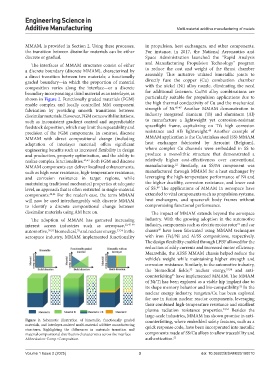
              The interfaces of MMAM structures consist of either   and Manufacturing Propulsion Technology” program
            a discrete boundary (discrete MMAM), characterized by   to reduce the cost and weight of the thrust chamber
            a direct transition between two materials; a functionally   assembly. This initiative utilized bimetallic joints to
            graded boundary—in which the proportion of material   directly fuse the copper (Cu) combustion chamber
            composition varies along the interface—or a discrete   with the nickel (Ni) alloy nozzle, eliminating the need
            boundary incorporating a third material as an interlayer, as   for additional fasteners. Cu/Ni alloy combinations are
            shown in Figure 2. Functionally graded materials (FGM)   particularly suitable for propulsion applications due to
            enable complex and locally controlled MM component   the high thermal conductivity of Cu and the mechanical
            fabrication  by  providing  smooth  transitions  between   strength of Ni. 45-47  Another MMAM demonstration in
            dissimilar materials. However, FGM comes with limitations,   industry integrated titanium (Ti) and aluminum (Al)
            such as inconsistent gradient control and unpredictable   to manufacture a lightweight yet corrosion-resistant
            feedstock deposition, which may limit the repeatability and   spaceflight frame, capitalizing on Ti’s high corrosion
                                                                                          48
            precision of the FGM components. In contrast, discrete   resistance and Al’s lightweight.  Another example of
            MMAM with direct compositional change (including   MMAM application is the Cu/stainless steel (SS) MMAM
            adaptation of interlayer material) offers significant   heat exchanger fabricated by Aerosint (Belgium),
            engineering benefits such as increased flexibility in design   where complex Cu channels were embedded in SS to
            and production, property optimization, and the ability to   produce a monolithic structure that demonstrated a
            realize complex functionalities. 42,43  Both FGM and discrete   relatively higher cost-effectiveness over conventional
                                                                           22
            MMAM components can deliver localized enhancements,   manufacturing.  Similarly, an SS/Ni component was
            such as high wear resistance, high-temperature resistance,   manufactured through MMAM for a heat exchanger by
            and corrosion resistance in target regions, while   leveraging the high-temperature performance of Ni and
            maintaining traditional mechanical properties at adequate   the higher ductility, corrosion resistance, and lower cost
                                                                    49
            level, an approach that is often restricted in single-material   of SS.  The applications of MMAM in aerospace have
            components. 40,44  For the reader’s ease, the term MMAM   extended to vital components such as propulsion systems,
            will  now  be  used  interchangeably  with  discrete  MMAM   heat exchangers, and spacecraft body frames without
            to identify a discrete compositional change between   compromising functional performance.
            dissimilar materials using AM here on.               The impact of MMAM extends beyond the aerospace
              The adoption of MMAM has garnered increasing     industry. With the growing adoption in the automotive
                                                                                                      51
            interest across industries such as aerospace, 22,45-49    industry, components such as electric motor rotor  and car
                                                                    50
            automotive, 50,51  biomedical,  and nuclear energy. 53,54  In the   chassis  have been fabricated using MMAM techniques
                                  52
            aerospace industry, MMAM implemented functionality   with  iron (Fe)/Ni and  Al/SS  compositions, respectively.
                                                               The design flexibility enabled through LPBF allowed for the
                                                               reduction of eddy currents and increased motor efficiency.
                                                               Meanwhile, the Al/SS MMAM chassis helped reduce the
                                                               vehicle’s weight while maintaining higher strength and
                                                               corrosion resistance. Similarly, to the automotive industry,
                                                               the biomedical fields,  nuclear energy, 53,54  and anti-
                                                                                  52
                                                               counterfeiting  have implemented MMAM. The MMAM
                                                                          55
                                                               of Ni/Ti has been explored as a viable hip implant due to
                                                               its shape memory behavior and bio-compatibility.  In the
                                                                                                       52
                                                               nuclear energy industry, tungsten/Cu has been explored
                                                               for use in fusion nuclear reactor components, leveraging
                                                               their combined high-temperature resistance and excellent
                                                               plasma radiation resistance properties. 53,54  Besides the
                                                               large-scale industries, MMAM has shown promise in anti-
            Figure  2.  Schematic illustration of bimetallic, functionally graded   counterfeiting, where embedded safety features, such as a
            materials, and interlayer-assisted multi-material additive manufacturing   quick response code, have been incorporated into metallic
            structures,  highlighting  the  differences  in  materials  transition  and
            material compositional distribution characteristics across the interface  components made of SS/Cu alloys to allow traceability and
            Abbreviation: Comp.: Composition.                  authentication. 55


            Volume 1 Issue 2 (2025)                         3                          doi: 10.36922/ESAM025180010

