


Page 25 - ESAM-1-4
P. 25
Engineering Science in
            Additive Manufacturing                                              Machine learning for biomedical metal AM


                           A                                   B


                        C
                                                 D                         E


                                                           11
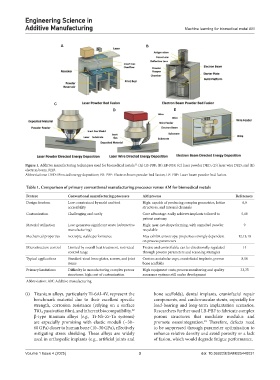
            Figure 1. Additive manufacturing techniques used for biomedical metals.  (A) LB-PBF; (B) EB-PBF; (C) laser powder DED; (D) laser wire DED; and (E)
            electron beam DED.
            Abbreviations: DED: Directed energy deposition; EB-PBF: Electron beam powder bed fusion; LB-PBF: Laser beam powder bed fusion.

            Table 1. Comparison of primary conventional manufacturing processes versus AM for biomedical metals
            Feature           Conventional manufacturing processes  AM process                       References
            Design freedom    Low: constrained by mold and tool   High: capable of producing complex geometries, lattice   6,9
                              accessibility                   structures, and internal channels
            Customization     Challenging and costly          Core advantage: easily achieves implants tailored to   5,10
                                                              patient anatomy
            Material utilization  Low: generates significant waste (subtractive   High: near-net-shape forming, with unmelted powder   9
                              manufacturing)                  recyclable
            Mechanical properties  Isotropic, stable performance  May exhibit anisotropy; properties strongly dependent   12,13,18
                                                              on process parameters
            Microstructure control  Limited by overall heat treatment, restricted   Precise and controllable; can be directionally regulated   14
                              control range                   through process parameters and scanning strategies
            Typical applications  Standard-sized bone plates, screws, and joint   Custom acetabular cups, craniofacial implants, porous   8,10
                              stems                           bone scaffolds
            Primary limitations  Difficulty in manufacturing complex porous   High equipment costs; process monitoring and quality   33,35
                              structures; high cost of customization  assurance systems still under development
            Abbreviation: AM: Additive manufacturing.

            (i)  Titanium alloys, particularly Ti-6Al-4V, represent the   bone scaffolds), dental implants, craniofacial repair
               benchmark material due to their excellent specific   components, and cardiovascular stents, especially for
               strength, corrosion resistance  (relying  on a  surface   load-bearing and long-term implantation scenarios.
               TiO₂ passivation film), and inherent biocompatibility.    Researchers further used LB-PBF to fabricate complex
                                                         22
               β-type titanium alloys (e.g., Ti-Nb-Zr-Ta systems)   porous structures that modulate modulus and
               are especially promising with elastic moduli (~30–  promote osseointegration.  Therefore, defects need
                                                                                        23
               60 GPa) closer to human bone (10–30 GPa), effectively   to be suppressed through parameter optimization to
               mitigating stress shielding. These alloys are  widely   enhance relative density and avoid porosity or a lack
               used in orthopedic implants (e.g., artificial joints and   of fusion, which would degrade fatigue performance.


            Volume 1 Issue 4 (2025)                         3                          doi: 10.36922/ESAM025440031

