


Page 29 - ESAM-1-4
P. 29
Engineering Science in
            Additive Manufacturing                                              Machine learning for biomedical metal AM


            ML, for enhancing quality assurance and advancing   2. ML-driven forward prediction of AM
            intelligent manufacturing in AM. Inayathullah  et al.    biomedical metals
                                                         62
            focused on physics-aware hybrid data approaches and
            evaluated the performance of various advanced ML   2.1. Overview
            algorithms in enhancing the precision and efficiency   Forward prediction in AM refers to the use of ML models to
            of AM. This review, therefore, narrows its scope to the   forecast the performance metrics of final products based on
            specific domain of ML applications in AM process of   known process parameters, material composition, or initial
            biomedical metals.                                 conditions.  This approach follows the process-structure–
                                                                        58
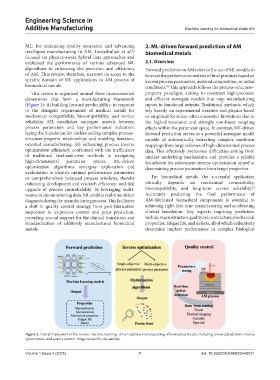
              This review is organized around three interconnected   property paradigm, aiming to construct high-precision
            dimensions that form a manufacturing framework     and efficient surrogate models that map manufacturing
            (Figure 3): (i) building forward predictability: in response   inputs to functional outputs. Traditional methods, which
            to the stringent requirements of medical metals for   rely heavily on experimental iteration and physics-based
            mechanical compatibility, biocompatibility, and service   or empirical formulas, often encounter limitations due to
            reliability, ML establishes surrogate models between   the high-dimensional and strongly non-linear coupling
            process parameters and key performance indicators,   effects within the parameter space. In contrast, ML-driven
            laying the foundation for understanding complex process-  forward prediction serves as a powerful surrogate model
            structure-property relationships and enabling function-  capable of automatically extracting complex nonlinear
            oriented manufacturing; (ii) enhancing process inverse   mappings from large volumes of high-dimensional process
            optimization efficiency: confronted with the inefficiency   data. This effectively overcomes difficulties arising from
            of traditional trial-and-error methods in navigating   unclear underlying mechanisms and provides a reliable
            high-dimensional  parameter  spaces,  ML-driven    foundation for subsequent inverse optimization aimed at
            optimization algorithms synergize exploration and   determining process parameters from target properties.
            exploitation to identify optimal performance parameters
            or comprehensively balanced process windows, thereby   For biomedical metals, the successful application
            enhancing development and research efficiency; and (iii)   critically  depends  on  mechanical  compatibility,
                                                                                                            63
            upgrade of process controllability: by leveraging multi-  biocompatibility, and long-term service reliability.
            source in situ monitoring data, ML enables real-time defect   Accurately predicting the final performance of
            diagnosis during the manufacturing process. This facilitates   AM-fabricated biomedical components is essential to
            a  shift  in  quality  control  strategy  from  post-fabrication   achieving right-first-time manufacturing and accelerating
            inspection to in-process control and prior prediction,   clinical translation. Key aspects requiring prediction
            providing crucial support for the clinical translation and   include macrostructure quality, microstructure, mechanical
            standardization of additively manufactured biomedical   properties, fatigue life, and defects, all of which collectively
            metals.                                            determine implant performance in complex biological


            Figure 3. Overall framework of the review: machine learning–driven additive manufacturing of biomedical metals, including forward prediction, inverse
            optimization, and quality control. Image created by the authors.


            Volume 1 Issue 4 (2025)                         7                          doi: 10.36922/ESAM025440031

