


Page 33 - ESAM-1-4
P. 33
Engineering Science in
            Additive Manufacturing                                              Machine learning for biomedical metal AM


            cross-printer knowledge transfer across three industrial   of each input feature to model predictions, thereby
            scenarios  and  significantly  reducing  the  experimental   revealing the influence mechanisms of process parameters
            burden for process qualification. In addition, Fang et al.,    on strength and ductility. As shown in  Figure  7, the
                                                         83
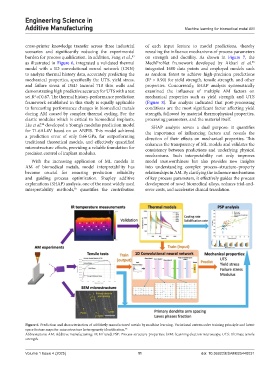
            as illustrated in  Figure  6, integrated a validated thermal   MechProNet framework developed by Akbari  et al.
                                                                                                            86
            model with a 1D convolutional neural network (CNN)   integrated 1600 data points and employed models such
            to analyze thermal history data, accurately predicting the   as random forest to achieve high-precision predictions
            mechanical properties,  specifically the  UTS, yield stress,   (R  > 0.90) for yield strength, tensile strength, and other
                                                                 2
            and failure stress of DED Inconel 718 thin walls and   properties. Concurrently, SHAP analysis systematically
            demonstrating high predictive accuracy for UTS with a test   examined  the  influence  of  multiple  AM  factors  on
            set R  of 0.67. The thermal history-performance prediction   mechanical properties such as yield strength and UTS
                2
            framework established in this study is equally applicable   (Figure  8). The analysis indicated that post-processing
            to forecasting performance changes in biomedical metals   conditions are the most significant factor affecting yield
            during AM caused by complex thermal cycling. For the   strength, followed by material thermophysical properties,
            elastic modulus which is critical to biomedical implants,   processing parameters, and the material itself.
            Liu et al.  developed a Young’s modulus prediction model   SHAP  analysis  serves  a  dual  purpose:  it  quantifies
                   84
            for Ti-6Al-4V based on an ANFIS. This model achieved   the importance of influencing factors and reveals the
            a prediction error of only 0.66 GPa, far outperforming   direction  of  their  effects  on  mechanical  properties.  This
            traditional theoretical models, and effectively quantified   enhances the transparency of ML models and validates the
            microstructure effects, providing a reliable foundation for   consistency between predictions and underlying physical
            precision control of implant modulus.              mechanisms. Such interpretability not only improves
              With the increasing application of ML models in   model trustworthiness but also provides new insights
            AM of biomedical metals, model interpretability has   into understanding complex process–structure–property
            become crucial for ensuring prediction reliability   relationships in AM. By clarifying the influence mechanisms
            and  guiding  process  optimization.  Shapley  additive   of key process parameters, it effectively guides the process
            explanations (SHAP) analysis, one of the most widely used   development of novel biomedical alloys, reduces trial-and-
            interpretability methods,  quantifies the contribution   error costs, and accelerates clinical translation.
                                 85


            Figure 6. Prediction and characterization of additively manufactured metals by machine learning. Variational autoencoder training principle and latent
            space feature maps for microstructure heterogeneity identification. 83
            Abbreviations: AM: Additive manufacturing; IR: Infrared; PSP: Process-structure-properties; SEM: Scanning electron microscopy; UTS: Ultimate tensile
            strength.


            Volume 1 Issue 4 (2025)                         11                         doi: 10.36922/ESAM025440031

