


Page 35 - ESAM-1-4
P. 35
Engineering Science in
            Additive Manufacturing                                              Machine learning for biomedical metal AM


            for predicting the fatigue behavior of actual components   and avoiding defects before production is a critical task for
            with  geometrical  features,  highlighting  its  substantial   ensuring product quality. In this context, ML, particularly
            practical engineering value. Regarding direct prediction   its important subfield, has demonstrated significant
            based on process parameters, Zhang et al.  constructed an   potential in key tasks such as defect identification,
                                             90
            ANFIS model for LB-PBF 316L stainless steel. The model   classification, and generation.
            successfully predicted high-cycle fatigue life using process   In the diagnosis and prediction of defect types, Lee
            parameters and post-processing parameters in conjunction   et al.  established an explainable ML framework for the
                                                                   94
            with the maximum cyclic stress, maintaining prediction   laser metal deposition process. The study used GPR to
            errors within an acceptable range. Similarly, Shen et al.    predict porosity and geometric dimensions, and an SVM
                                                         91
            employed feature engineering to optimize a multilayer   to classify defect types (e.g., gas pores, keyholes, and lack
            perceptron model for Ti-6Al-4V  alloy. By  incorporating   of fusion), achieving an overall accuracy exceeding 0.93.
            defect  characteristics  obtained  from  micro-CT  scans,   Through SHAP analysis, the influence weight of various
            they established a high-precision fatigue life prediction   process parameters on defect formation was systematically
            model and explicitly identified defect location as the   quantified. Results indicated that the powder feeding
            most critical factor influencing life. Evidently, the ML   rate  had the greatest  impact  on  the deposited  height,
            prediction of fatigue life is evolving from a reliance solely   while laser power was the most critical factor controlling
            on process parameters toward an integrated framework                      95
            that incorporates mechanical loading conditions with key   porosity. Similarly, Gui et al.  designed and fabricated 32
            defect characteristics such as size, shape, and location.  sets  of  S30C  samples  with  different  process  parameters
                                                               and conducted actual inspection and classification of
            2.6. Defect forward prediction                     internal defects using X-ray CT and SEM. By employing
                                                               quantitative surface morphology parameters as defect
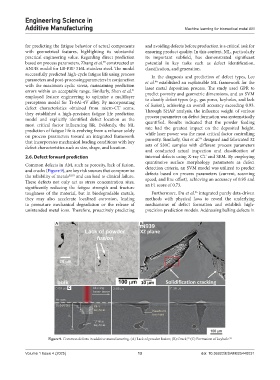
            Common defects in AM, such as porosity, lack of fusion,   detection criteria, an SVM model was utilized to predict
            and cracks (Figure 9), are key risk sources that compromise   defects  based on process parameters (current, scanning
            the reliability of metals 92,93  and can lead to clinical failure.   speed, and line offset), achieving an accuracy of 0.95 and
            These defects not only act as stress concentration sites,   an F1 score of 0.73.
            significantly reducing the fatigue strength and fracture
            toughness of the material, but in biodegradable metals,   Furthermore, Du et al.  integrated purely data-driven
                                                                                    96
            they may also accelerate localized corrosion, leading   methods with physical laws to reveal the underlying
            to  premature  mechanical  degradation  or  the  release  of   mechanisms of defect formation and establish high-
            unintended metal ions. Therefore, proactively predicting   precision prediction models. Addressing balling defects in


                         A                                   B


                              C


                      Figure 9. Common defects in additive manufacturing. (A) Lack of powder fusion; (B) Crack;  (C) Formation of keyhole. 93
                                                                                 92

            Volume 1 Issue 4 (2025)                         13                         doi: 10.36922/ESAM025440031

