


Page 38 - ESAM-1-4
P. 38
Engineering Science in
            Additive Manufacturing                                              Machine learning for biomedical metal AM


                         A


                         B


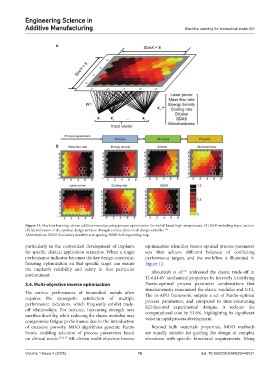
            Figure 11. Machine learning–driven additive manufacturing process optimization for nickel-based high-temperature. (A) SOM including input vectors.
            (B) Identification of the optimal design window through contour plots of all design variables. 114
            Abbreviations: SDAS: Secondary dendrite arm spacing; SOM: Self-organizing map.

            particularly in the customized development of implants   optimization identifies Pareto-optimal process parameter
            for specific clinical application scenarios. When a single   sets that achieve different balances of conflicting
            performance indicator becomes the key design constraint,   performance  targets,  and  the  workflow  is  illustrated  in
            focusing optimization on that specific target can ensure   Figure 12.
            the  implant’s  reliability  and  safety  in  that  particular   Aboutaleb  et al.  addressed the classic trade-off in
                                                                               107
            environment.
                                                               Ti-6Al-4V mechanical properties by inversely identifying
            3.4. Multi-objective inverse optimization          Pareto-optimal process parameter  combinations  that
                                                               simultaneously maximized the elastic modulus and UTS.
            The service performance of biomedical metals often   The  m-APO  framework  outputs  a  set  of  Pareto-optimal
            requires the synergistic satisfaction of multiple   process parameters, and compared to time-consuming
            performance indicators, which frequently exhibit trade-
            off relationships. For instance, increasing strength may   full-factorial experimental designs, it reduces the
                                                               computational cost by 51.8%, highlighting its significant
            sacrifice ductility, while reducing the elastic modulus may
            compromise fatigue performance due to the introduction   value in rapid process development.
            of  excessive  porosity.  MOO algorithms  generate  Pareto   Beyond bulk materials properties, MOO methods
            fronts,  enabling selection of process parameters  based   are equally suitable for guiding the design of complex
            on clinical needs. 116,117  ML-driven multi-objective inverse   structures with specific functional requirements. Meng


            Volume 1 Issue 4 (2025)                         16                         doi: 10.36922/ESAM025440031

