


Page 43 - ESAM-1-4
P. 43
Engineering Science in
            Additive Manufacturing                                              Machine learning for biomedical metal AM


            rather to enable the model to learn and memorize the data   process is deviating from normal conditions, or when ML
            patterns characteristic of qualified states through extensive   models predict impending defects, the system instantly
            normal process data. Once real-time sensor signals deviate   generates commands to dynamically adjust process
            significantly from this learned normal pattern, the system   parameters (e.g., laser power and scan speed), thus steering
            automatically triggers an anomaly alert. Models like   the process back on track and preventing defects.  Within
                                                                                                      150
            autoencoders learn intrinsic patterns and distributions   such a closed-loop framework, ML plays an indispensable
            from large amounts of normal data, enabling them to   role: it enables accurate, real-time diagnosis, and prediction
            identify anomalous signals deviating from these patterns.    of process states and quality indicators by automatically
                                                         146
            Abranovic et al.  employed a convolutional long short-  extracting features from multi-sensor data and establishing
                         147
            term memory autoencoder (ConvLSTM Autoencoder).    high-dimensional, non-linear mappings.  This capability
                                                                                               151
            Trained unsupervised using only video sequences of   to create a quantitative, intelligent process-quality mapping
            molten pools under normal operating conditions, the   provides the foundational insight necessary for precise
            model quantified process stability through its ability to   parameter adjustments.
            predict future frames. This approach successfully achieved   Effective parameter tuning is central to realizing such
            online detection and localization of four typical defects   closed-loop control, and a variety of practical approaches
            without requiring any annotated defect data.       have been developed. Gerdes et al.  predesigned and
                                                                                             123
              Therefore, ML-based real-time diagnosis lays the core   implemented a programmed feedforward control strategy
            foundation for achieving closed-loop control, transitioning   involving an automatic increase in print speed at the
                                                                                                 152
            from  sensing  to decision-making  and execution.    midpoint of the print path. Armstrong et al.  employed 3D
                                                         148
            The ultimate goal of an intelligent monitoring system   laser scanning between layers to detect geometric errors,
            is not merely to identify defects but also to dynamically   thereby adjusting subsequent layer paths and parameters.
            intervene in the process parameters by integrating ML’s   Both of these methods are effective ways to improve the
            decision-making capabilities with the actuators of the   geometric accuracy and consistency of printed structures
            AM equipment, thereby proactively suppressing defect   during the AM process.
            formation.  This  facilitates  a  fundamental  shift  in  the   The above-mentioned control models of parameter
            quality control paradigm from post-inspection toward   tuning establish the practical foundation for closed-loop
            online prediction and adaptive manufacturing.      control. To achieve higher level autonomous optimization,
                                                               strategies such as model predictive control (MPC) are
            4.4. Closed-loop control and adaptive              widely adopted. This approach utilizes dynamic models to
            manufacturing
                                                               predict future behavior and optimize parameter adjustment
            The ultimate objective of quality monitoring is to integrate   decisions. A core challenge in this field is obtaining accurate
            the sensing and decision-making capabilities of ML with   and efficient dynamic system models, with the technical
            the actuators of AM to create an intelligent closed-loop   approach evolving from traditional methods toward data-
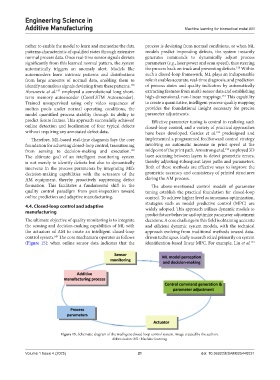
            control system.  The core mechanism operates as follows   driven techniques. Early research relied primarily on system
                        149
            (Figure  15): when online sensor data indicates that the   identification-based linear MPC. For example, Liu et al.
                                                                                                            153


                           Figure 15. Schematic diagram of the intelligent closed-loop control system. Image created by the authors.
                                                 Abbreviation: ML: Machine learning.


            Volume 1 Issue 4 (2025)                         21                         doi: 10.36922/ESAM025440031

