


Page 41 - ESAM-1-4
P. 41
Engineering Science in
            Additive Manufacturing                                              Machine learning for biomedical metal AM


                          A


                          B


                          C


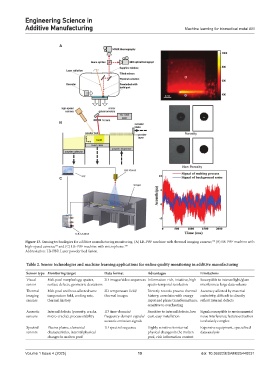
            Figure 13. Sensing technologies for additive manufacturing monitoring. (A) LB-PBF machine with thermal imaging camera;  (B) LB-PBF machine with
                                                                                           128
            high-speed camera;  and (C) LB-PBF machine with microphone. 138
                        132
            Abbreviation: LB-PBF: Laser powder bed fusion.
            Table 2. Sensor technologies and machine learning applications for online quality monitoring in additive manufacturing
            Sensor type Monitoring target    Data format        Advantages            Limitations
            Visual   Melt pool morphology, spatter,   2D images/video sequences Information-rich, intuitive, high  Susceptible to intense light/glare
            sensor   surface defects, geometric deviations      spatio-temporal resolution  interference; large data volume
            Thermal   Melt pool and heat-affected zone   2D temperature field/  Directly records process thermal  Accuracy affected by material
            imaging   temperature field, cooling rate,   thermal images  history; correlates with energy   emissivity; difficult to directly
            sensors  thermal history                            input and phase transformations;  reflect internal defects
                                                                sensitive to overheating
            Acoustic   Internal defects (porosity, cracks,   1D time-domain/  Sensitive to internal defects, low  Signals susceptible to environmental
            sensors  micro-cracks), process stability  frequency-domain signals/ cost, easy installation  noise interference; feature extraction
                                             acoustic emission signals                is relatively complex
            Spectral   Plasma plume, elemental   1D spectral sequence  Highly sensitive to internal   Expensive equipment, specialized
            sensors  characteristics, internal physical         physical changes in the molten   data analysis
                     changes in molten pool                     pool; rich information content


            Volume 1 Issue 4 (2025)                         19                         doi: 10.36922/ESAM025440031

