


Page 42 - ESAM-1-4
P. 42
Engineering Science in
            Additive Manufacturing                                              Machine learning for biomedical metal AM


            fused heterogeneous sensor data from a co-axial pyrometer   state to be automatically classified. These models can learn
            and a high-speed video camera and developed a sequential   defect features directly from image data, enabling the
            decision analysis neural network model to achieve accurate   current state to be automatically classified. For instance,
            prediction and assessment of the geometric quality of   Scime  et al.  addressed powder bed anomalies during
                                                                         144
            single tracks in LB-PBF.                           the LB-PBF process by constructing a multi-scale CNN
                                                               using an enhanced AlexNet architecture to automatically
            4.3. Application of ML methods in real-time defect   analyze grayscale images of the powder bed after powder
            detection                                          spreading. This model autonomously learned and achieved

            In the AM process, ML provides a powerful technical   high-precision recognition and classification of six types of
            means for achieving in situ process monitoring and quality   powder bed anomalies, achieving an overall classification
            assessment by analyzing real-time multi-source sensor   accuracy of 97% while pinpointing defects with pixel-level
                                                                                                            145
            data. Based on the characteristics of data and challenges   precision. Similarly, in the L-DED process, Chen et al.
            encountered in actual production, two primary technical   developed a multi-sensor fusion digital twin framework
            approaches have emerged: precise identification and   based on supervised learning strategies. This model enables
            localization of known defects, and acute detection of   real-time identification and localization of known defect
            unknown anomalies when labeled samples are scarce.  types such as cracks and critical-pore voids, subsequently
                                                               generating a virtual quality map registered with the part’s
              Supervised learning methods play a crucial role when
            common defect types in manufacturing processes, such as   3D volume, achieving a defect classification accuracy of
                                                               96%. It significantly outperforms single-sensor approaches,
            spatter, spheroidization, and poor powder distribution, are   thereby demonstrating the effectiveness and robustness of
            well understood and sufficient annotated data have been   supervised methods in multimodal fusion scenarios.
            accumulated.  For  in situ  quality monitoring  of  LB-PBF,
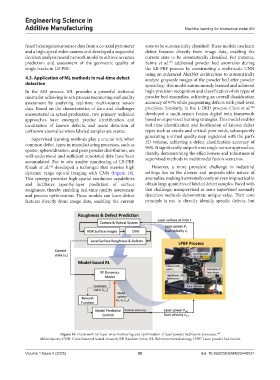
            Knaak et al.   developed  a  technique  that  marries  high   However, a more prevalent challenge in industrial
                      143
            dynamic range optical imaging with CNN (Figure  14).   settings lies in the diverse and unpredictable nature of
            This synergy provides high-spatial-resolution capabilities   anomalies, making it extremely costly or even impractical to
            and facilitates layer-by-layer prediction of surface   obtain large quantities of labeled defect samples. Faced with
            roughness, thereby enabling real-time quality assessment   this challenge, unsupervised or semi-supervised anomaly
            and process optimization. These models can learn defect   detection methods demonstrate unique value. Their core
            features directly from image data, enabling the current   principle is not to directly identify specific defects, but


                           Figure 14. Framework for layer-wise monitoring and optimization of laser powder bed fusion processes. 143
                  Abbreviations: CNN: Convolutional neural network; RF: Random forest; RL: Reinforcement learning; LPBF: Laser powder bed fusion.


            Volume 1 Issue 4 (2025)                         20                         doi: 10.36922/ESAM025440031

