


Page 31 - ESAM-1-4
P. 31
Engineering Science in
            Additive Manufacturing                                              Machine learning for biomedical metal AM


                          A


                          B


                          C


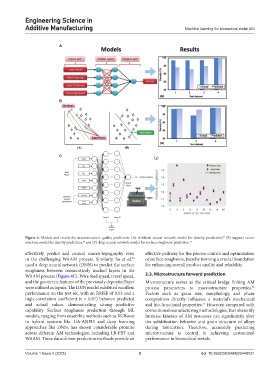
            Figure 4. Models and results for macrostructure quality prediction. (A) Artificial neural network model for density prediction;  (B) support vector
                                                                                                68
            machine model for density prediction;  and (C) deep neural network model for surface roughness prediction. 75
                                    68
            effectively  predict  and  control  macro-topography  even   effective pathway for the precise control and optimization
            in  the  challenging  WAAM  process.  Similarly,  So  et al.    of surface roughness, thereby forming a crucial foundation
                                                         75
            used a deep neural network (DNN) to predict the surface   for enhancing overall product quality and reliability.
            roughness between consecutively stacked layers in the
            WAAM process (Figure 4C). Wire feed speed, travel speed,   2.3. Microstructure forward prediction
            and the geometric features of the previously deposited layer   Microstructure serves as the critical bridge linking AM
            were utilized as inputs. The DNN model exhibited excellent   process parameters to macrostructure properties.
                                                                                                            76
            performance on the test set, with an RMSE of 0.03 and a   Factors such as grain size, morphology, and phase
            high correlation coefficient (r = 0.97) between predicted   composition directly influence a material’s mechanical
            and actual values, demonstrating strong predictive   and bio-functional properties.  However, compared with
                                                                                       77
            capability. Surface roughness prediction through ML   conventional manufacturing methodologies, the inherently
            models, ranging from ensemble methods such as XGBoost   intricate kinetics of AM processes can significantly alter
            to hybrid systems like GA-ANFIS and deep learning   the solidification behavior and grain structure of alloys
            approaches like DNN, has shown considerable promise   during fabrication. Therefore, accurately predicting
            across different AM technologies, including LB-PBF and   microstructure is central to achieving customized
            WAAM. These data-driven prediction methods provide an   performance in biomedical metals.


            Volume 1 Issue 4 (2025)                         9                          doi: 10.36922/ESAM025440031

