


Page 27 - ESAM-1-4
P. 27
Engineering Science in
            Additive Manufacturing                                              Machine learning for biomedical metal AM


            frequently challenging to acquire due to concerns regarding   predict unknown data. Supervised learning is further
            commercial sensitivity. 41,42  To address fundamental   divided into regression and classification. Regression
            challenges such as data scarcity, heterogeneity, and   primarily handles continuous variables, while
            insufficient high-quality labeled data, researchers employ   classification deals with discrete variables. Regression
            diverse  strategies,  including  multimodal  data  fusion   algorithms encompass a range of methods, including
            and transfer learning. Subsequent preprocessing steps,   linear regression, Gaussian process regression (GPR),
            including data sampling, anomaly detection and handling,   and regression trees. The applications of regression
            data discretization, and standardization, have been shown   algorithms in the field of AM primarily encompass
            to enhance training efficiency and prediction accuracy.  the following: process window prediction, process

              The objective of feature engineering is to extract or   parameter optimization, alloy property prediction,
            construct features that are most representative of the   geometric deviation control, and closed-loop
            prediction target from raw data, thus serving as a key factor   control. Common classification algorithms include
            in enhancing model performance. Common methods        linear discriminant analysis, naïve Bayes, support
            include principal component analysis, independent     vector machines (SVM), K-nearest neighbors,
            component analysis, categorical encoding, and clustering.   random forest, and classification trees. 48,49  The
            The process of feature engineering has been shown to   primary applications of these algorithms encompass
            reduce dimensionality, thereby eliminating redundancy   defect detection, quality assessment, and geometric
            and highlighting key parameters that influence material   deviation control.
            properties. 43,44                                  (ii)  Unsupervised  learning:  Unsupervised  learning
              Model selection and training involve choosing       algorithms are characterized by their ability to
            appropriate ML algorithms based on specific tasks and data   function without the requirement of labeled input-
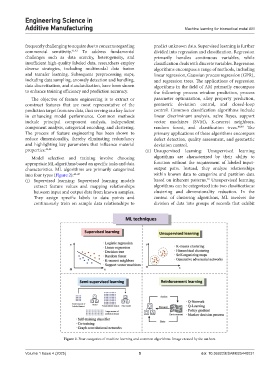
            characteristics. ML algorithms are primarily categorized   output pairs. Instead, they analyze relationships
            into four types (Figure 2): 45-47                     within known data to categorize and partition data
            (i)  Supervised learning: Supervised learning models   based on inherent patterns.  Unsupervised learning
                                                                                         50
               extract feature values and mapping relationships   algorithms can be categorized into two classifications:
               between input and output data from known samples.   clustering and dimensionality reduction. In the
               They assign specific labels to data points and     context of clustering algorithms, ML involves the
               continuously train on sample data relationships to   division  of  data  into  groups  of  records  that exhibit


                            Figure 2. Four categories of machine learning and common algorithms. Image created by the authors.


            Volume 1 Issue 4 (2025)                         5                          doi: 10.36922/ESAM025440031

