


Page 49 - GHES-1-1
P. 49
Global Health Econ Sustain                                            Resilience, income, artists, COVID-19


            and their lower 95% CI for all these items were above 2.5   higher resilience during the pandemic was related to
            (thus closer to “true nearly all the time”).       increased  productivity,  stimulated  commitment,  and  a
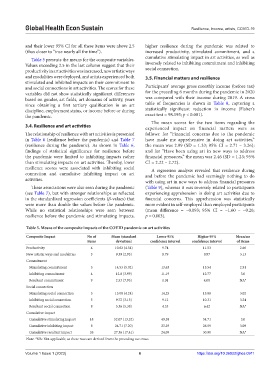
              Table 5 presents the means for the composite variables.   cumulative stimulating impact in art activities, as well as
            Values exceeding 2.5 in the last column suggest that their   inversely related to inhibiting commitment and inhibiting
            productivity in art activities was increased, new artistic ways   social connection.
            and modalities were deployed, and artists experienced both   3.5. Financial matters and resilience
            stimulated and inhibited impacts on their commitment to
            and social connections in art activities. The scores for these   Participants’ average gross monthly income (before tax)
            variables did not show statistically significant differences   for the preceding 6 months during the pandemic in 2020
            based on gender, art fields, art domains of activity, years   was compared with  their income during  2019. A  cross
            since  obtaining  a first tertiary  qualification  in an  art   table of frequencies is shown in  Table 8, capturing a
            discipline, employment status, or income before or during   statistically significant reduction in income (Fisher’s
            the pandemic.                                      exact test = 98.193; p < 0.001).
                                                                 The mean scores for the two items regarding the
            3.4. Resilience and art activities                 experienced impact on financial matters were as
            The relationship of resilience with art activities is presented   follows: for “Financial concerns due to the pandemic
            in  Table 6  (resilience before the pandemic) and  Table 7   have made me apprehensive in doing art activities,”
            (resilience during the pandemic). As shown in  Table 6,   the mean was 2.99 (SD = 1.33; 95% CI = 2.71 – 3.26);
            findings of statistical significance for resilience before   and for “Have been using art in new ways to address
            the pandemic were limited to inhibiting impacts rather   financial pressures,” the mean was 2.46 (SD = 1.23; 95%
            than stimulating impacts on art activities. Thereby, lower   CI = 2.22 – 2.72).
            resilience scores were associated with inhibiting social   A regression analysis revealed that resilience during
            connection and cumulative inhibiting impact on art   and before the pandemic had seemingly nothing to do
            activities.                                        with using art in new ways to address financial pressures
              These associations were also seen during the pandemic   (Table 9), whereas it was inversely related to participants
            (see Table 7), but with stronger relationships as reflected   experiencing apprehension in doing art activities due to
            in the standardized regression coefficients (β-values) that   financial concerns. This apprehension was statistically
            were more than double the values before the pandemic.   more evident in self-employed than employed participants
            While no statistical relationships were seen between   (mean  difference =  −0.093; 95% CI  = −1.60  – −0.26;
            resilience before the pandemic and stimulating impacts,   p = 0.003).


            Table 5. Means of the composite impacts of the COVID pandemic on art activities
            Composite Impact          No of     Mean (standard      Lower 95%        Higher 95%      Mean/no
                                      items       deviation)     confidence interval  confidence interval  of items
            Productivity                4         10.62 (4.54)        9.74             11.53           2.66
            New artistic ways and modalities  3   9.39 (2.93)         8.79              9.97           3.13
            Commitment
             Stimulating commitment     5         14.53 (5.02)        13.63            15.54           2.91
             Inhibiting commitment      4         12.0 (3.99)         11.19            12.77           3.0
             Resultant commitment       9         2.53 (7.95)         1.01              4.08           NA*
            Social connection
             Stimulating social connection  5     15.08 (4.24)        14.25            15.88           3.02
             Inhibiting social connection  3      9.72 (3.13)         9.12             10.31           3.24
             Resultant social connection  8       5.36 (5.38)         4.33              6.42           NA*
            Cumulative impact
             Cumulative stimulating impact  18    52.07 (13.52)       49.58            54.71           3.0
             Cumulative inhibiting impact  8      24.71 (7.20)        23.29            26.09           3.09
             Cumulative resultant impact  26      27.36 (17.41)       24.09            30.90           NA*
            Note: *NA: Not applicable, as these rows are derived from the preceding two rows.


            Volume 1 Issue 1 (2023)                         6                        https://doi.org/10.36922/ghes.0911

