


Page 51 - GHES-1-1
P. 51
Global Health Econ Sustain                                            Resilience, income, artists, COVID-19


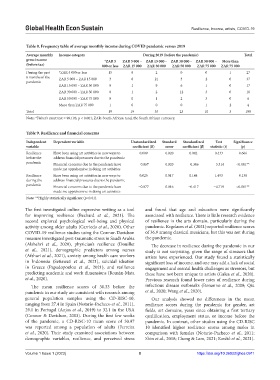
            Table 8. Frequency table of average monthly income during COVID pandemic versus 2019
            Average monthly   Income category                 During 2019 (before the pandemic)          Total
            gross income                     *ZAR 5   ZAR 5 000 –  ZAR 15 000 –  ZAR 30 000 –  ZAR 50 000 –   More than
            (before tax)                    000 or less  ZAR 15 000  ZAR 30 000  ZAR 50 000  ZAR 75 000  ZAR 75 000

            During the past   *ZAR 5 000 or less  15     9         2          0         0          1      27
            6 months of the   ZAR 5 000 – ZAR 15 000  3  8         21         3         2          0      37
            pandemic
                          ZAR 15 000 – ZAR 30 000  0     1         9          6         1          0      17
                          ZAR 30 000 – ZAR 50 000  0     1         2         12         3          0      18
                          ZAR 50 000 – ZAR 75 000  0     0         1          2         3          0      6
                          More than ZAR 75 000  1        0         0          0         1          2      4
            Total                              19        19        35        23         10         3     109
            Note: *Fisher’s exact test = 98.193; p < 0.001; ZAR: South African rand, the South African currency.


            Table 9. Resilience and financial concerns
            Independent   Dependent variable             Unstandardized   Standard   Standardized   Test   Significance
            variable                                     coefficient (B)  error  coefficient (β)  statistic (t)  (p)
            Resilience   Have been using art activities in new ways to   0.009  0.020  0.042  0.433    0.666
            before the   address financial pressures due to the pandemic
            pandemic    Financial concerns due to the pandemic have   −0.067  0.020  −0.306  −3.314   <0.001**
                        made me apprehensive in doing art activities
            Resilience   Have been using art activities in new ways to   0.025  0.017  0.144  1.493    0.138
            during the   address financial pressures due to the pandemic
            pandemic    Financial concerns due to the pandemic have   −0.077  0.016  −0.417  −4.719   <0.001**
                        made me apprehensive in doing art activities
            Note: **Highly statistically significant (p<0.01).

            The first investigated online expressive writing as a tool   and found that age and education were significantly
            for improving resilience (Bechard  et al., 2021). The   associated with resilience. There is little research evidence
            second explored psychological well-being and physical   of  resilience in  the  arts  domain, particularly during the
            activity among older adults (Carriedo et al., 2020). Other   pandemic. Kegelaers et al. (2021) reported resilience scores
            COVID-19 resilience studies using the Connor-Davidson   of 36.9 among classical musicians, but this was not during
            measure investigated post-traumatic stress in Saudi Arabia   the pandemic.
            (Alshehri  et al., 2020), physician’s resilience (Douillet   The decrease in resilience during the pandemic in our
            et al.,  2021), demographic  predictors among  nurses   study is not surprising, given the range of stressors that
            (Afshari et al., 2021), anxiety among health care workers   artists have experienced. Our study found a statistically
            in Indonesia (Setiawati  et al., 2021), suicidal ideation   significant loss of income, and one may add a lack of social
            in Greece (Papadopoulou  et al., 2021), and resilience   engagement and mental health challenges as stressors, but
            predicting academic and work dimensions (Román-Mata   these have not been unique to artists (Galea et al., 2020).
            et al., 2020).                                     Previous research found lower rates of resilience during
              The  mean  resilience  scores  of  30.33  before  the   infectious disease outbreaks (Bonanno  et al., 2008; Qiu
            pandemic in our study are consistent with research among   et al., 2020; Wang et al., 2020).
            general  population  samples  using  the  CD-RISC-10,   Our analysis showed no differences in the mean
            ranging from 27.4 in Spain (Notario-Pacheco et al., 2011),   resilience  scores  during  the  pandemic  for  gender,  art
            29.1 in Portugal (Anjos et al., 2019) to 32.1 in the USA   fields, art domains, years since obtaining a first tertiary
            (Connor & Davidson, 2003). During the first few weeks   qualification, employment status, or income before the
            of the pandemic, a CD-RISC-10 mean score of 30.97   pandemic. In contrast, other studies using the CD-RISC
            was reported among a population of adults (Ferreira   10 identified higher resilience scores among males in
            et al., 2020). Their study examined associations between   comparison with females (Notario-Pacheco  et  al., 2011;
            demographic variables, resilience, and perceived stress   Shin et al., 2018; Cheng & Lam, 2021; Kavčič et al., 2021).


            Volume 1 Issue 1 (2023)                         8                        https://doi.org/10.36922/ghes.0911

