


Page 59 - GHES-1-1
P. 59
Global Health Econ Sustain                                               Musicians and COVID-19 in Brazil


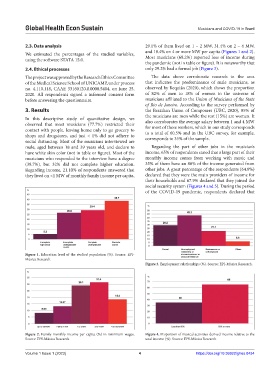
            2.3. Data analysis                                 29.1% of them lived on 1 – 2 MW, 31.4% on 2 – 4 MW,

            We estimated the percentages of the studied variables,   and 18.4% on 4 or more MW per capita (Figures 1 and 2).
            using the software STATA 15.0.                     Most musicians (68.2%) reported loss of income during
                                                               the pandemic (not in table or figure). It is noteworthy that
            2.4. Ethical processes                             only 29.2% had a formal job (Figure 3).
            The project was approved by the Research Ethics Committee   The data above corroborate research in the area
            of the Medical Science School of UNICAMP, under process   that indicates the predominance of male musicians, as
            no. 4.110.118, CAAE 33160120.8.0000.5404, on June 25,   observed by Requião (2020), which shows the proportion
            2020. All respondents signed a informed consent form   of 82% of men to 18% of women in the universe of
            before answering the questionnaire.                musicians affiliated to the Union of Musicians of the State
                                                               of Rio de Janeiro. According to the survey performed by
            3. Results                                         the Brazilian Union of Composers (UBC, 2020), 85% of

            In  this  descriptive  study  of  quantitative  design,  we   the musicians are men while the rest (15%) are women. It
            observed that most musicians (77.7%) restricted their   also corroborates the average salary between 1 and 4 MW
            contact with people, leaving home only to go grocery to   for most of these workers, which in our study corresponds
                                                               to a total of 60.5% and in the UBC survey, for example,
            shops and drugstores, and just < 1% did not adhere to   corresponds to 35% of the sample.
            social distancing. Most of the musicians interviewed are
            male, aged between 18 and 39 years old, and declare to   Regarding the part of other jobs in the musician’s
            have white skin color (not in table or figure). Most of the   income, 65% of respondents stated that a large part of their
            musicians who responded to the interview have a degree   monthly income comes from working with music and
            (38.7%), but 32% did not complete higher education.   35% of them have an 80% of the income generated from
            Regarding income, 21.10% of respondents answered that   other jobs. A great percentage of the respondents (64.9%)
            they lived on <1 MW of monthly family income per capita,   declared that they were the main providers of income for
                                                               their households and 67.9% declared that they joined the
                                                               social security system (Figures 4 and 5). During the period
                                                               of the COVID-19 pandemic, respondents declared that


            Figure 1. Education level of the studied population (%). Source: EPI-
            Música Research.
                                                               Figure 3. Employment relationships (%). Source: EPI-Música Research.


            Figure  2. Family monthly income per capita (%) in minimum wages.   Figure 4. Proportion of musical activities-derived income relative to the
            Source: EPI-Música Research.                       total income (%). Source: EPI-Música Research.


            Volume 1 Issue 1 (2023)                         4                        https://doi.org/10.36922/ghes.0434

