


Page 80 - GHES-1-2
P. 80
Global Health Econ Sustain                                             Imports of essential medical products


            2020 and the value 0 indicates otherwise; and expected   2 partners (one extra-EU and one intra-EU), spanning
            values of β β β >0, and of β <0.                   6 years (2015 – 2020). Table 1 presents the main statistics
                                   4
                    2,  3,  5
              In the field of international trade, numerous previous   of the variables that make up the equations for the panel
            studies have employed regression models with panel data   sample. In addition, two dummies are included: One
            estimated by pooled OLS, FE, and RE (Karagoz & Saray,   represents the intra- or extra-EU origin of the products,
            2010; Manwa et al., 2019; Tran et al., 2020; Majumder et al.,   and the other captures whether COVID-19 had had a
            2020,  among  others).  The  Breusch-Pagan  and  Hausman   notable effect on the trade in these goods. All variables
            tests were used to determine the most appropriate   were sourced from Eurostat.
            estimation method. Based on the interpretation by    As presented in  Table  1, the goods registering the
            Wooldridge (2010), pooled OLS assumes that the intercept   highest volume of imports on average in the period 2015
            and slope coefficients are constant across time and space,   – 2020 were medical consumables and disinfectants.
            and the error term captures differences over time and   Germany is the biggest importer of all the medical
            among individuals. The Breusch and Pagan Lagrangian   products analyzed, while the minimum values correspond
            multiplier test was used to select a model, either the pooled   to extra-EU imports of products by Latvia (test kits),
            OLS or the RE. In this case, two hypotheses were proposed:  Luxembourg (disinfectants, medical consumables, and
               H : The appropriate model is pooled OLS.        oxygen therapy equipment), Estonia (medical devices),
                 0
               H : The appropriate model is RE.                and Malta (protective garments and vehicles). Regarding
                 1
              If Prob > Chi2 < 0.05, H  can be rejected, and the   the rest of the variables, the maximum value for GDPpc
                                    0
            appropriate model is RE.                           corresponds to Luxembourg, the maximum number of
                                                               beds  per 100,000 inhabitants and population of people
              To choose between FE and RE, Hausman specification   aged over 65 to Germany, and the highest HICP to Finland.
            tests were used. Intervariance and intravariability were
            considered in selecting one model in this case. The   The variable “beds”  refers to the available beds in
            proposed hypotheses are:                           hospitals. Given the lack of information regarding beds
                                                               for 2019 and 2020, a value was estimated by extrapolating
               H : The preferred model is RE.                  from the trend of the four years before 2019. Regarding
                 0
               H : The preferred model is FE.                  population,  the  analysis  was  focused  on  the  number
                 1
              If Prob > Chi2 is more than 0.05, H  can be accepted,   of people aged over 65, as this age group is the most
                                            0
            and the preferred model is RE.                     vulnerable to COVID-19. GDPpc represents the level of
                                                               wealth of the importing country valued at market prices;
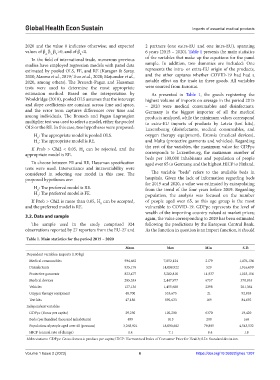
            3.2. Data and sample                               again, the value corresponding to 2020 has been estimated
              The sample used in the study comprised 324       following the predictions by the European Central Bank.
            observations reported by 27 reporters from the EU-27 and   As the function in question is an import function, it should

            Table 1. Main statistics for the period 2015 – 2020
                                                      Mean              Max             Min             S.D.
            Dependent variables: imports (100 kg)
             Medical consumables                      994,662          7,852,124        2179           1,476,134
             Disinfectants                            935,176         14,008,922         529           1,916,699
             Protective garments                      823,477          5,282,810        11,937         1,023,156
             Medical devices                          285,353          2,447,977        6757           378,933
             Vehicles                                 127,136          1,455,688        2298           201,364
             Oxygen therapy equipment                 48,700           535,675           21             92,095
             Test kits                                47,186           892,633           169            84,692
            Independent variables
             GDPpc (Euros per capita)                 29,230           102,200          6370            19,420
             Beds (per hundred thousand inhabitants)   499               813             200             168
             Population of people aged over 65 (persons)  3,268,921   18,090,682        79,805         4,543,532
             HICP (annual rate of change)               1.4              7.1             −8.4            1.8
            Abbreviations: GDPpc: Gross domestic product per capita; HICP: Harmonized Index of Consumer Price for Health; S.D.: Standard deviation.


            Volume 1 Issue 2 (2023)                         6                        https://doi.org/10.36922/ghes.1207

