


Page 81 - GHES-1-2
P. 81
Global Health Econ Sustain                                             Imports of essential medical products


            include a variable that reflects the price of these products,   demand, which was superseded by disinfectant in 2020,
            that is, HICP, which  measures the change over time in   as the latter is an essential good needed to prevent the
            the prices of consumer goods and services related to the   transmission of the  virus and  to sanitize  the surfaces
            health sector.  Table  2  shows the matrix of correlations   in affected areas. Overall, a substantial increase in the
            among GDPpc, beds, population of people aged over 65,   volume of import is observed in 2020, with the exception
            and HICP.                                          of test kits.

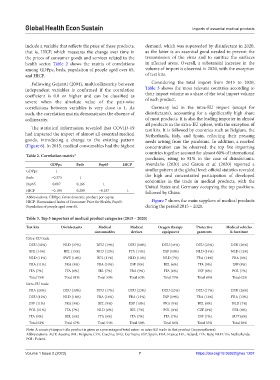
              Following Gujarati (2004), multicollinearity between   Considering the total import from 2015 to 2020,
            independent variables is confirmed  if the  correlation   Table  3  shows the most  relevant countries according  to
            coefficient is 0.8 or higher and can be classified as   their import volume as a share of the total import volume
            severe when the absolute value of the pair-wise    of each product.
            correlations between  variables  is very close to  1.  As   Germany led in the  intra-EU import (except for
            such, the correlation matrix demonstrates the absence of   disinfectants), accounting for a significantly high share
            collinearity.                                      of most products. It is also the leading importer in almost
                                                               all products in the extra-EU sphere, with the exception of
              The statistical information revealed that COVID-19   test kits. It is followed by countries such as Belgium, the
            had impacted the import of almost all essential medical   Netherlands, Italy, and Spain, reflecting their pressing
            goods, introducing a change to the existing pattern   needs arising from the pandemic. In addition, a marked
            (Figure 6). In 2015, medical consumables had the highest   concentration can be observed: the top five importing
                                                               countries together account for almost 60% of international
            Table 2. Correlation matrix*
                                                               purchases, rising to 81% in the case of disinfectants.
                      GDPpc      Beds      Pop65     HICP      Avendaño (2020) and García  et  al. (2020) reported a
            GDPpc        1                                     similar pattern at the global level: official statistics revealed
            Beds       −0.373      1                           the high and concentrated participation of developed
                                                               economies in the trade in medical products, with the
            Pop65      0.007      0.166      1                 United States and Germany occupying the top positions,
            HICP       −0.194     0.200    −0.187      1       followed by China.
            Abbreviations: GDPpc: Gross domestic product per capita;
            HICP: Harmonized Index of Consumer Price for Health; Pop65:   Figure 7 shows the main suppliers of medical products
            Population of people aged over 65.                 during the period 2015 – 2020.

            Table 3. Top 5 importers of medical product categories (2015 – 2020)

            Test kits      Disinfectants   Medical      Medical     Oxygen therapy   Protective   Medical vehicles
                                         consumables     devices      equipment      garments      & furniture
            Extra-EU trade
             DEU (32%)      NLD (37%)     DEU (19%)     DEU (18%)     DEU (44%)     DEU (23%)      DEU (26%)
             BEL (14%)      BEL (15%)     NLD (12%)     ITA (14%)     ESP (10%)     NLD (14%)      NLD (12%)
             NLD (11%)      SWE (10%)     BEL (11%)     NLD (13%)     NLD (7%)       FRA (14%)      FRA (8%)
             FRA (11%)      FRA (8%)      FRA (10%)     ESP (9%)       BEL (6%)      ITA (9%)       ESP (8%)
             ITA (7%)        ITA (6%)      IRL (7%)     FRA (9%)       ITA (6%)      ESP (8%)       POL (7%)
             Total 75%      Total 81%      Total 59%    Total 63%      Total 79%     Total 69%      Total 62%
            Intra-EU trade
             FRA (20%)      DEU (30%)     DEU (17%)     DEU (23%)     DEU (23%)     DEU (17%)      DEU (26%)
             DEU (12%)      NLD (16%)     FRA (16%)     FRA (13%)     ESP (19%)      FRA (13%)     FRA (13%)
             ESP (11%)      FRA (8%)       BEL (9%)     ESP (10%)      FRA (9%)      BEL (8%)       NLD (7%)
             POL (11%)       ITA (7%)     NLD (6%)      BEL (7%)       POL (8%)      CZE (8%)       BEL (6%)
             ITA (9%)        BEL (6%)      ITA (6%)     ITA (7%)       ITA (7%)      ESP (7%)       AUT (6%)
             Total 63%      Total 67%      Total 54%    Total 58%      Total 66%     Total 53%      Total 58%
            Note: A country’s import of a product is given as a percentage of total extra- or intra-EU trade in that product (in parentheses).
            Abbreviations: AUT: Austria; BEL: Belgium; CZE: Czechia; DEU: Germany; ESP: Spain; FRA: France; IRL: Ireland; ITA: Italy; NLD: The Netherlands;
            POL: Poland.


            Volume 1 Issue 2 (2023)                         7                        https://doi.org/10.36922/ghes.1207

