


Page 22 - GHES-2-1
P. 22
Global Health Econ Sustain                                            Global South: Healthier lives with UVC


            the  United  Nation’s  Sustainable  Development  Goals  and  emphasizing  the  significance  of  universal  access  to
            improved WASH (safe water, sanitation, and hygiene) conditions.


            Keywords: Diarrhea; Disinfection; Economic impact; Global South; Ultraviolet C light-emitting diode technology; Waterborne
            diseases


            1. Introduction
            Waterborne diseases pose a significant public health
            challenge, particularly in the Global South. The Global
            South refers to countries and regions located primarily
            in Africa, Asia, Latin America, and the Caribbean, where
            socioeconomic and infrastructural factors contribute
            to heightened vulnerability to waterborne diseases
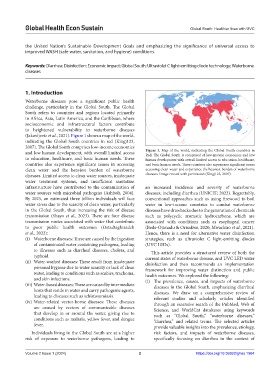
            (Jakovljevic et al., 2021). Figure 1 shows a map of the world,
            indicating the Global South countries in red (Kingj123,
            2007). The Global South comprises low-income economies
            and low human development, with overall limited access   Figure  1. Map of  the world, indicating the Global South countries in
                                                               Red. The Global South is comprised of low-income economies and low
            to education, healthcare, and basic human needs. These   human development with overall limited access to education, healthcare,
            countries also experience significant issues in accessing   and basic human needs. These countries also experience significant issues
            clean water and the heaviest burden of waterborne   accessing clean water and experience the heaviest burden of waterborne
            diseases. Limited access to clean water sources, inadequate   diseases. Image reused with permission (Kingj123, 2007).
            water  treatment  systems,  and  insufficient  sanitation
            infrastructure have contributed to the contamination of   an increased incidence and severity of waterborne
            water sources with microbial pathogens (Ashbolt, 2004).   diseases, including diarrhea (UNICEF, 2022). Regrettably,
            By 2025, an estimated three billion individuals will face   conventional approaches such as using firewood to boil
            water stress due to the scarcity of clean water, particularly   water in low-income countries to combat waterborne
            in the Global South, thus increasing the risk of disease   diseases have drawbacks due to the generation of chemicals
            transmission (Shayo et al., 2023). There are four disease   such as polycyclic aromatic hydrocarbons, which are
            transmission routes associated with water that contribute   associated with conditions such as esophageal cancer
            to poor public health outcomes (Ostadtaghizadeh    (Bede-Ojimadu & Orisakwe, 2020; Mwachiro et al., 2021).
            et al., 2022):                                     Hence, there is a need for alternative water disinfection
            (i)  Waterborne diseases: These are caused by the ingestion   strategies, such as ultraviolet C light-emitting diodes
               of contaminated water containing pathogens, leading   (UVC LEDs).
               to illnesses such as diarrheal diseases, cholera, and   This  article  provides  a  structured review of  both  the
               typhoid.                                        current states of waterborne disease, and UVC LED water
            (ii)  Water-washed diseases: These result from inadequate   disinfection and then recommends an implementation
               personal hygiene due to water scarcity or lack of clean   framework for improving water distinction and public
               water, leading to conditions such as scabies, trachoma,   health outcomes. We explored the following:
               and skin infections.                            (i)  The prevalence, causes, and impacts of waterborne
            (iii) Water-based diseases: These are caused by intermediate   diseases in the Global South, emphasizing diarrheal
               hosts that reside in water and carry pathogenic agents,   diseases. We draw on a comprehensive review of
               leading to diseases such as schistosomiasis.       relevant studies and scholarly articles identified
            (iv)  Water-related vector-borne diseases:  These diseases   through an extensive search of the PubMed, Web of
               are caused by vectors of communicable diseases     Science, and WorldCat databases using keywords
               that develop in or around the water, giving rise to   such as “Global South,” “waterborne diseases,”
               conditions such as malaria, yellow fever, and dengue   “diarrhea,” and related terms. The selected articles
               fever.
                                                                  provide valuable insights into the prevalence, etiology,
              Individuals living in the Global South are at a higher   risk factors, and impacts of waterborne diseases,
            risk of exposure to waterborne pathogens, leading to   specifically focusing on diarrhea in the context of


            Volume 2 Issue 1 (2024)                         2                        https://doi.org/10.36922/ghes.1984

