


Page 26 - GHES-2-1
P. 26
Global Health Econ Sustain                                            Global South: Healthier lives with UVC


            2.2.3. Impact on quality of life

            Poor  WASH     conditions  also  impact  schools,
            multigenerational  households,  and  community
            organizations (Centers for Disease Control and
            Prevention, NCEZID, Division of Foodborne, Waterborne,
            and Environmental Diseases, 2020). Without access to
            sanitation facilities or clean drinking water, schools cannot
            provide safe environments for children to learn, which
            contributes to the increased absenteeism of students who
            either personally suffer from diarrheal diseases or must
            assume caretaking responsibilities for family members
            experiencing disease symptoms. In addition, students
            who must take on household responsibilities or enter the
            workforce  in  place  of  their  parents  due  to  losses  from
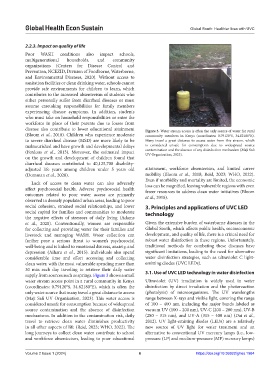
            disease also contribute to lower educational attainment   Figure 3. Water stream access is often the only source of water for rural
            (Bloom et al., 2018). Children who experience moderate   community members  in Kenya  (coordinates:  0.79120°S,  34.82180°E).
            to severe diarrheal disease (MSD) are more likely to be   Many travel a great distance to  access water  from this stream,  which
            malnourished and have growth and developmental delays   is considered unsafe for consumption due to widespread source
            (Ferdous  et al.,  2013).  Moreover,  the  estimated  impact   contamination and the absence of any disinfection mechanism (Maji Safi
                                                               UV Organization, 2023).
            on the growth and development of children found that
            diarrheal diseases contributed to 40,125,700 disability-
            adjusted life years among children under 5  years old   attainment, workforce absenteeism, and limited career
            (Domman et al., 2020).                             mobility (Bloom  et al., 2018; Reid, 2023; WHO, 2022).
                                                               Even if morbidity and mortality are limited, the economic
              Lack of access to clean water can also adversely   loss can be magnified, leaving vulnerable regions with even
            affect psychosocial health. Adverse psychosocial health   fewer resources to address clean water initiatives (Bloom
            outcomes related to poor water access are primarily   et al., 2018).
            observed in densely populated urban areas, leading to poor
            social cohesion, strained social relationships, and lower   3. Principles and applications of UVC LED
            social  capital  for  families  and  communities  to  moderate   technology
            the negative effects of stressors of daily living (Adams
            et al., 2020). Conventionally, women are responsible   Given the extensive burden of waterborne diseases in the
            for collecting and providing water for their families and   Global South, which affects public health, socioeconomic
            livestock and managing WASH. Water collection can   development, and quality of life, there is a critical need for
            further pose a serious threat to women’s psychosocial   robust water disinfection in these regions. Unfortunately,
            well-being and is linked to emotional distress, anxiety, and   traditional methods for  combating  these  diseases  have
            depression (Aihara  et al., 2015). Individuals also spend   significant limitations, leading to the need for alternative
            considerable time and effort accessing and collecting   water disinfection strategies, such as ultraviolet C light-
            clean water, with the most vulnerable spending more than   emitting diodes (UVC LEDs).
            30  min each day traveling to retrieve their daily water
            supply from sources such as springs. Figure 3 shows a small   3.1. Use of UVC LED technology in water disinfection
            water stream access point in a rural community in Kenya   Ultraviolet  (UV)  irradiation  is  widely  used  in  water
            (coordinates: 0.79120°S, 34.82180°E), which is often the   disinfection by  direct  irradiation and the  photoreaction
            only water source that many travel a great distance to access   (photolysis) of microorganisms. The UV wavelengths
            (Maji  Safi  UV  Organization,  2023).  This  water  access  is   range between X-rays and visible light, covering the range
            considered unsafe for consumption because of widespread   of 100 – 400  nm, including the major bands labeled as
            source  contamination and the absence  of  disinfection   vacuum UV (100 – 200 nm), UV-C (200 – 280 nm), UV-B
            mechanisms. In addition to the contamination risk, daily   (280 – 315 nm), and UV-A (315 – 400 nm) (Dai et al.,
            travel to retrieve clean water diminishes productivity   2012). UV light-emitting diodes (LEDs) are a relatively
            in all other aspects of life (Reid, 2023; WHO, 2022). The   new source of UV light for water treatment and an
            long journeys to collect clean water contribute to school   alternative to conventional UV mercury lamps (i.e., low-
            and workforce absenteeism, leading to poor educational   pressure (LP) and medium-pressure (MP) mercury lamps)


            Volume 2 Issue 1 (2024)                         6                        https://doi.org/10.36922/ghes.1984

