


Page 27 - GHES-2-1
P. 27
Global Health Econ Sustain                                            Global South: Healthier lives with UVC


            that  emit  nearly  monochromatic  irradiation  at  254  nm   is consumed or used for sanitation and hygiene purposes
            or polychromatic irradiation (200+ nm), respectively,   (Li  et al., 2019).
            absorbed by nucleic acids in microorganisms.         Several action spectra studies have proven a direct
              Unlike conventional UVC lamps, UVC LEDs are      correlation between the spectral sensitivity of DNA
            compact, have lower energy demands, and operate on   and RNA and the absorbance spectrum of the tested
            DC power, enabling compatibility with solar panels for a   microorganisms. Figure 4 shows the wavelength sensitivity
            comparably longer lifespan (Matafonova & Batoev, 2018).   of the microorganisms, where MS2 and Qbeta were used as
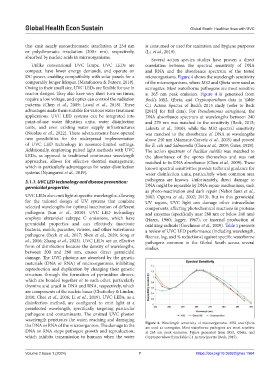
            Owing to their small size, UVC LEDs are flexible for use in   surrogates. Most waterborne pathogens are most sensitive
            reactor designs. They also have very short turn-on times,   at 265  nm peak emission.  Figure  4 is generated from
            require a low voltage, and optics can control the radiation   Beck’s MS2, Qbeta, and  Cryptosporidium  data in  Table
            patterns (Chen  et al., 2009; Lawal  et al., 2018). These   C.1  Action  Spectra  of  Beck’s  2015  study  (refer  to  Beck
            advantages make them suitable for various water treatment   [2015] for full data). For  Pseudomonas aeruginosa, the
            applications. UVC LED systems can be integrated into   DNA absorbance spectrum at wavelengths between 240
            point-of-use water filtration units, water disinfection   and 270  nm was matched to the sensitivity (Beck, 2015;
            units, and even existing water supply infrastructures   Lakretz  et al., 2010), while the MS2 spectral sensitivity
            (Nicolau et al., 2022). These advancements have opened   was matched to the absorbance of DNA at wavelengths
            new possibilities for the widespread implementation   above 240 nm (Mamane-Gravetz et al., 2005) and proved
            of UVC LED technology in resource-limited settings.   for E. coli and Salmonella (Chen et al., 2009; Gates, 1929).
            Additionally, employing pulsed light methods with UVC   The action spectrum of  Bacillus subtilis was matched to
            LEDs,  as opposed  to traditional  continuous  wavelength   the absorbance of the spores themselves and was not
            approaches, allows for effective thermal management,   matched to its DNA absorbance (Chen et al., 2009). These
            which is particularly advantageous for water-disinfection   known spectral sensitivities provide technical guidance for
            systems (Nyangaresi et al., 2019).                 water disinfection units, particularly when common area

            3.1.1. UVC LED technology and disease prevention:   pathogens  are known.  Unfortunately, direct damage  to
            germicidal properties                              DNA might be reparable by DNA-repair mechanisms, such
                                                               as photo-reactivation and dark repair (Nebot Sanz et al.,
            UVC LEDs also emit light at specific wavelengths, allowing   2007; Oguma  et al., 2002; 2013). But in this germicidal
            for the tailored design of UV systems that combine   UV region, UVC light can damage other intracellular
            selected wavelengths for optimal inactivation of different   components, affecting photochemical reactions in proteins
            pathogens (Sun  et  al., 2010). UVC LED technology   and enzymes (specifically near 280 nm or below 240 nm)
            employs  ultraviolet  subtype  C emissions, which have   (Harm, 1980; Jagger, 1967), or internal production of
            germicidal  properties  and  can  effectively  inactivate   oxidizing radicals (Gerchman et al., 2019). Table 1 presents
            bacteria, molds, parasites, viruses, and other waterborne   a review of UVC LED performance (including wavelength,
            pathogens (Beck  et al., 2017; Shen  et al., 2020; Song  et   fluence, log, and % reductions) against specific waterborne
            al., 2016; Zhang et al., 2023). UVC LEDs are an effective   pathogens common in the Global South across several
            form of disinfection because the density of wavelengths,   studies.
            between 200 and 280  nm, causes direct germicidal
            damage. The UVC photons are absorbed by the genetic
            materials (DNA or RNA) of microorganisms, inhibiting
            reproduction and duplication by changing their genetic
            structure through the formation of pyrimidine dimers,
            which are bonded together or to each other, particularly
            thymine and uracil in DNA and RNA, respectively, which
            are components of the nucleic bases (Chatterley & Linden,
            2010; Choi et al., 2006; Li et al., 2019). UVC LEDs, as a
            disinfection method, are configured to emit light at a
            preselected wavelength, specifically targeting particular
            pathogens and contaminants. The emitted UVC photon
            wavelength penetrates the water, reaching and damaging
            the DNA or RNA of the microorganism. The damage to the   Figure  4. Wavelength sensitivity of microorganisms. MS2 and Qbeta
                                                               are used as surrogates. Most waterborne pathogens are most sensitive
            DNA or RNA stops pathogen growth and reproduction,   at 265  nm peak emission.  Figure generated from MS2, Qbeta, and
            which inhibits  transmission to humans when the water   Cryptosporidium from Table C.1 Action Spectra (Beck, 2015).


            Volume 2 Issue 1 (2024)                         7                        https://doi.org/10.36922/ghes.1984

