


Page 93 - GHES-2-1
P. 93
Global Health Econ Sustain                                   Job satisfaction and burnout in the catering industry


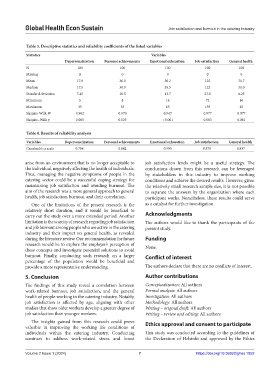
            Table 3. Descriptive statistics and reliability coefficients of the listed variables
            Statistics                                           Variables
                             Depersonalization  Personal achievements  Emotional exhaustion  Job satisfaction  General health
            N                     100               100                100              100            100
            Missing                0                 0                  0                0             0
            Mean                  17.8              36.0               36.2             122           31.7
            Median                17.5              38.0               35.5             122           31.0
            Standard deviation    7.45              10.5               13.7             23.8          6.23
            Minimum                5                 8                  14               72            16
            Maximum               35                55                  63              195            45
            Shapiro-Wilk W       0.962             0.970               0.947            0.977         0.977
            Shapiro–Wilk p       0.005             0.023              < 0.001           0.083         0.081


            Table 4. Results of reliability analysis
            Variables       Depersonalization  Personal achievements  Emotional exhaustion  Job satisfaction  General health
            Cronbach’s α scale   0.784             0.842               0.903           0.878          0.837

            arise from an environment that is no longer acceptable to   job satisfaction levels might be a useful strategy. The
            the individual, negatively affecting the health of individuals.   conclusions drawn from this research can  be leveraged
            Thus, managing the negative symptoms of people in the   by stakeholders in this industry to improve working
            catering  sector  could be  a  successful  coping  strategy  for   conditions and achieve the desired results. However, given
            maintaining job satisfaction and avoiding burnout. The   the relatively small research sample size, it is not possible
            aim of the research was a more general approach to general   to  separate  the  answers  by  the  organization  where  each
            health, job satisfaction, burnout, and their correlation.  participant works. Nonetheless, these results could serve

              One of the limitations of the present research is the   as a catalyst for further investigation.
            relatively short duration, and it would be beneficial to
            carry out the study over a more extended period. Another   Acknowledgments
            limitation is the scarcity of research regarding job satisfaction   The authors would like to thank the participants of the
            and job burnout among people who are active in the catering   present study.
            industry and their impact on general health, as revealed
            during the literature review. Our recommendation for future   Funding
            research would be to explore the employer’s perception of   None.
            these concepts and investigate potential solutions to avoid
            burnout. Finally, conducting such research on a larger   Conflict of interest
            percentage of the population would be beneficial and
            provide a more representative understanding.       The authors declare that there are no conflicts of interest.

            5. Conclusion                                      Author contributions
            The findings of this study reveal a correlation between   Conceptualization: All authors
            work-related burnout, job satisfaction, and the general   Formal analysis: All authors
            health of people working in the catering industry. Notably,   Investigation: All authors
            job satisfaction is affected by age, aligning with other   Methodology: All authors
            studies that show older workers develop a greater degree of   Writing – original draft: All authors
            job satisfaction than younger workers.             Writing – review and editing: All authors

              The insights gained from this research could prove   Ethics approval and consent to participate
            valuable in improving the working life conditions of
            individuals within the catering industry. Conducting   This study was conducted according to the guidelines of
            seminars to address work-related stress and boost   the  Declaration  of Helsinki  and approved by  the  Ethics


            Volume 2 Issue 1 (2024)                         7                        https://doi.org/10.36922/ghes.1852

