


Page 92 - GHES-2-1
P. 92
Global Health Econ Sustain                                   Job satisfaction and burnout in the catering industry


            Table 1. Correlation matrix
            Variables          Depersonalization  Personal achievements  Emotional exhaustion  Job satisfaction  General health
            Depersonalization
             Pearson’s r            —
             DF                     —
             p-value                —
            Personal achievements
             Pearson’s r           0.077              —
             DF                     98                —
             p-value               0.446              —
            Emotional exhaustion
             Pearson’s r           0.637             0.066               —
             DF                     98                98                 —
             p-value               < 0.001           0.513               —
            Job satisfaction
             Pearson’s r           −0.294            0.179             −0.388            —
             DF                     98                98                 98              —
             p-value               0.003             0.075             < 0.001           —
            General health
             Pearson’s r           −0.216            0.236             −0.529           0.285          —
             DF                     98                98                 98              98            —
             p-value               0.031             0.018             < 0.001          0.004          —
            Abbreviation: DF=Degrees of freedom.


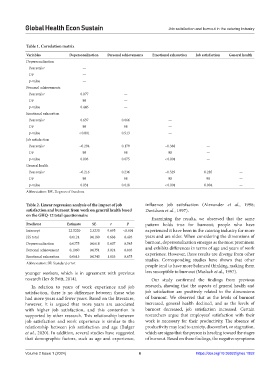
            Table 2. Linear regression analysis of the impact of job   influence  job  satisfaction  (Alexander  et al.,  1998;
            satisfaction and burnout from work on general health based   Davidson et al., 1997).
            on the GHQ‑12 total questionnaire
                                                                 Examining the results, we observed that the same
            Predictor         Estimate  SE      t      P       pattern holds true for burnout; people who have
            Intercept         22.5220  2.3230  9.695  <0.001   experienced it have been in the catering industry for more
            JSS total          0.0124  0.0180  0.688  0.493    years and are older. When considering the dimensions of
            Depersonalization  0.0375  0.0618  0.607  0.545    burnout, depersonalization emerges as the most prominent
            Personal achievement  0.1060  0.0351  3.024  0.003  and exhibits differences in terms of age and years of work
            Emotional exhaustion  0.0613  0.0340  1.803  0.075  experience. However, these results are diverge from other
                                                               studies. Corresponding studies have shown that other
            Abbreviation: SE: Standard error.
                                                               people tend to have more balanced thinking, making them
            younger workers, which is in agreement with previous   less susceptible to burnout (Maslach et al., 1997).
            research (Jex & Britt, 2014).                        Our study confirmed the findings from previous
              In relation to years of work experience and job   research, showing that the aspects of general health and
            satisfaction,  there  is  no  difference  between  those  who   job satisfaction are positively related to the dimensions
            had more years and fewer years. Based on the literature,   of burnout. We observed that as the levels of burnout
            however, it is argued that more years are associated   increased, general health declined, and as the levels of
            with higher job satisfaction, and this contention is   burnout decreased, job satisfaction increased. Certain
            supported by other research. This relationship between   researchers argue that employees’ satisfaction with their
            job satisfaction and work experience is similar to the   work is necessary for their productivity. The absence of
            relationship between job  satisfaction and age  (Bulger   productivity may lead to anxiety, discomfort, or stagnation,
            et al., 2020). In addition, several studies have suggested   which are signs that the person is heading toward the stages
            that demographic factors, such as age and experience,   of burnout. Based on these findings, the negative symptoms


            Volume 2 Issue 1 (2024)                         6                        https://doi.org/10.36922/ghes.1852

