


Page 144 - GHES-2-2
P. 144
Global Health Econ Sustain                                             The influence of coverage expansion


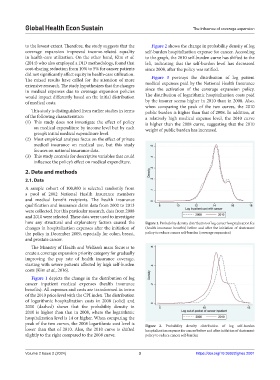
            to the lowest extent. Therefore, the study suggests that the   Figure 2 shows the change in probability density of log
            coverage expansion improved income-related equality   self-burden hospitalization expense for cancer. According
            in health-care utilization. On the other hand, Kim et al.   to the graph, the 2010 self-burden curve has shifted to the
            (2014) who also employed a DID methodology, found that   left, indicating that the self-burden level has decreased
            cost-sharing reduction from 10% to 5% for cancer patients   since 2008, after the policy was ratified.
            did not significantly affect equity in health-care utilization.
            The mixed results have called for the attention of more   Figure  3  portrays  the  distribution  of  log  patient
            extensive research. The study hypothesizes that the changes   medical expenses paid by the National Health Insurance
            in medical expenses due to coverage expansion policies   since the activation of the coverage expansion policy.
            would impact differently based on the initial distribution   The distribution of logarithmic hospitalization costs paid
            of medical costs.                                  by the insurer seems higher in 2010 than in 2008. Also,
                                                               when comparing the  peak of  the two curves, the 2010
              This study is distinguished from earlier studies in terms   public burden is higher than that of 2008. In addition, at
            of the following characteristics:                  a relatively high medical expense level, the 2010 curve
            (1)  This study does not investigate the effect of policy   is higher than the 2008 curve, suggesting that the 2010
               on medical expenditure by income level but by each   weight of public burden has increased.
               group’s initial medical expenditure level.
            (2)  Most empirical analyses focus on the effect of private
               medical insurance on medical use, but this study
               focuses on national insurance data.
            (3)  This study controls for descriptive variables that could
               influence the policy’s effect on medical expenditure.

            2. Data and methods
            2.1. Data
            A sample cohort of 100,000 is selected randomly from
            a pool of 2002 National Health Insurance members
            and medical benefit recipients. The health insurance
            qualification and insurance claim data from 2002 to 2013
            were collected. For this particular research, data from 2008
            and 2010 were selected. These data were used to investigate
            how any structural and explanatory factors caused the   Figure 1. Probability density distribution of log cancer hospitalization fee
            changes in hospitalization expenses after the initiation of   (health insurance benefits) before and after the initiation of abatement
            the policy in December 2009, especially for colon, breast,   policy to reduce cancer self-burden (coverage expansion)
            and prostate cancer.
              The Ministry of Health and Welfare’s main focus is to
            create a coverage expansion priority category for gradually
            improving the pay rate of health insurance coverage,
            starting with severe patients affected by high self-burden
            costs (Kim et al., 2016).
              Figure 1 depicts the change in the distribution of log
            cancer  inpatient  medical  expenses  (health  insurance
            benefits). All expenses and costs are transformed in terms
            of the 2010 price level with the CPI index. The distribution
            of logarithmic hospitalization costs in 2008 (solid) and
            2010 (dashed) shows that the probability density in
            2010 is higher than that in 2008, where the logarithmic
            hospitalization level is 14 or higher. When comparing the
            peak of the two curves, the 2008 logarithmic cost level is   Figure  2. Probability density distribution of log self-burden
            lower than that of 2010. Also, the 2010 curve is shifted   hospitalization expense for cancer before and after initiation of abatement
            slightly to the right compared to the 2008 curve.  policy to reduce cancer self-burden


            Volume 2 Issue 2 (2024)                         3                        https://doi.org/10.36922/ghes.2001

