


Page 125 - GHES-2-4
P. 125
Global Health Economics and
            Sustainability
                                                                                Fiscal policy shocks and health outcomes


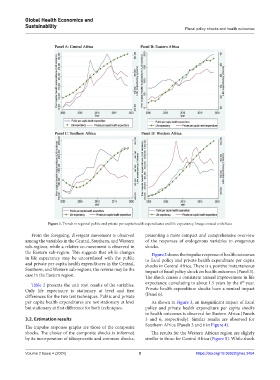
                     Figure 1. Trends in regional public and private per capita health expenditures and life expectancy. Image created with Stata

              From the foregoing, divergent movement is observed   presenting a more compact and comprehensive overview
            among the variables in the Central, Southern, and Western   of the responses of endogenous variables to exogenous
            sub-regions, while a relative co-movement is observed in   shocks.
            the Eastern sub-region. This suggests that while changes   Figure 2 shows the impulse response of health outcomes
            in life expectancy may be uncorrelated with the public   to fiscal policy and private health expenditure per capita
            and private per capita health expenditures in the Central,   shocks in Central Africa. There is a positive instantaneous
            Southern, and Western sub-regions, the reverse may be the   impact of fiscal policy shock on health outcomes (Panel 3).
            case in the Eastern region.                        The shock causes a consistent annual improvement in life
                                                                                                        th
              Table 2 presents the unit root results of the variables.   expectancy, cumulating to about 1.5 years by the 8  year.
            Only life expectancy is stationary at level and first   Private health expenditure shocks have a neutral impact
            differences for the two test techniques. Public and private   (Panel 6).
            per capita health expenditures are not stationary at level   As shown in Figure 3, an insignificant impact of fiscal
            but stationary at first difference for both techniques.  policy and private health expenditure per capita shocks
                                                               to health outcomes is observed for Eastern Africa (Panels
            3.2. Estimation results                            3 and 6, respectively). Similar results are observed for
            The impulse response graphs are those of the composite   Southern Africa (Panels 3 and 6 in Figure 4).
            shocks. The choice of the composite shocks is informed   The results for the Western African region are slightly
            by its incorporation of idiosyncratic and common shocks,   similar to those for Central Africa (Figure 5). While shock


            Volume 2 Issue 4 (2024)                         5                        https://doi.org/10.36922/ghes.3454

