


Page 129 - GHES-2-4
P. 129
Global Health Economics and
            Sustainability
                                                                                Fiscal policy shocks and health outcomes


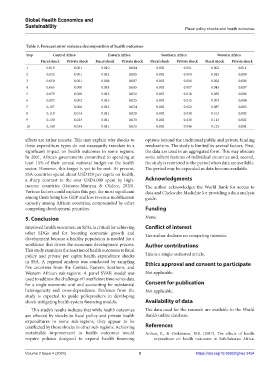
            Table 3. Forecast error variance decomposition of health outcomes
            Step        Central Africa         Eastern Africa         Southern Africa        Western Africa
                  Fiscal shock  Private shock  Fiscal shock  Private shock  Fiscal shock  Private shock  Fiscal shock  Private shock
            1        0.019      0.001       0.010       0.004      0.002       0.001       0.002      0.011
            2        0.032      0.001       0.012       0.005      0.002       0.004       0.012      0.009
            3        0.050      0.001       0.008       0.007      0.002       0.006       0.028      0.008
            4        0.065      0.000       0.014       0.005      0.003       0.007       0.043      0.007
            5        0.079      0.000       0.012       0.021      0.003       0.010       0.059      0.006
            6        0.093      0.002       0.013       0.025      0.003       0.015       0.073      0.004
            7        0.107      0.006       0.012       0.024      0.002       0.022       0.087      0.003
            8        0.119      0.014       0.011       0.028      0.002       0.030       0.101      0.002
            9        0.130      0.023       0.011       0.030      0.002       0.038       0.113      0.002
            10       0.140      0.034       0.011       0.031      0.002       0.046       0.125      0.001

            effects are rather minute. This may explain why shocks to   options beyond the traditional public and private funding
            these expenditure types do not necessarily translate to a   mechanisms. The study is limited by several factors. First,
            significant impact on health outcomes in some regions.   the data are used in an aggregated form. This may obscure
            In 2001, African governments committed to spending at   some salient features of individual countries and, second,
            least 15% of their annual national budget on the health   the study is restricted to the period when data are available.
            sector. However, this target is yet to be met. At present,   The period may be expanded as data become available.
            SSA countries spend about USD129 per capita on health,
            a sharp contrast to the over USD4,000 spent by high-  Acknowledgments
            income countries (Gatome-Munyua & Olalere, 2020).   The author acknowledges the World Bank for access to
            Various factors could explain this gap, the most significant   data and Chekwube Madichie for providing a data analysis
            among them being low GDP and low revenue mobilization   guide.
            capacity among African countries, compounded by other
            competing development priorities.                  Funding
            5. Conclusion                                      None.

            Improved health outcomes, an SDG, is critical for achieving   Conflict of interest
            other  SDGs  and  for  boosting  economic  growth  and   The author declares no competing interests.
            development because a healthy population is needed for a
            workforce that drives the economic development process.   Author contributions
            This study examines the reaction of health outcomes to fiscal
            policy and private per capita health expenditure shocks   This is a single-authored article.
            in SSA. A  regional analysis was conducted by sampling   Ethics approval and consent to participate
            five countries from the Central, Eastern, Southern, and
            Western African sub-regions. A  panel SVAR model was   Not applicable.
            used to address the challenge of insufficient time series data
            for a single economic unit and accounting for substantial   Consent for publication
            heterogeneity  and  cross-dependence.  Evidence  from  the   Not applicable.
            study is expected to guide policymakers in developing
            shock-mitigating health system financing models.   Availability of data

              This study’s results indicate that while health outcomes   The data used for the research are available in the World
            are affected by shocks to fiscal policy and private health   Bank’s online database.
            expenditures in some sub-regions, they appear to be
            unaffected by those shocks in other sub-regions. Achieving   References
            sustainable improvement in health outcomes would   Arthur,  E.,  &  Oaikhenan,  H.E.  (2017).  The  effects  of  health
            require policies designed to expand health financing   expenditure on  health  outcomes  in  Sub-Saharan Africa.


            Volume 2 Issue 4 (2024)                         9                        https://doi.org/10.36922/ghes.3454

