


Page 126 - GHES-2-4
P. 126
Global Health Economics and
            Sustainability
                                                                                Fiscal policy shocks and health outcomes


            Table 2. Unit root test results                    sub-regions to 0.03% and 0.05% in Eastern and Southern
                                                               Africa, respectively.
            Region  Variable      IPS            LLC
                              Level  1  Diff.  Level  1st Diff.  4. Discussion
                                      st
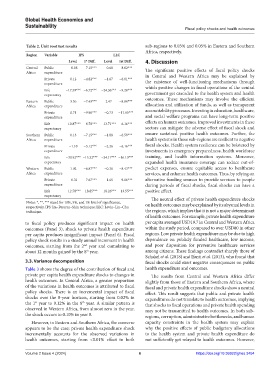
            Central   Public   −0.08  −7.15***   −0.68  −8.62***  The significant positive effects of fiscal policy shocks
            Africa  expenditure
                    Private    0.12  −4.82***  −1.67  −6.01***  in Central and Western Africa may be explained by
                    expenditure                                the existence of well-functioning mechanisms through
                    Life     −17.59*** −6.72***  −24.36*** −9.20***  which positive changes in fiscal operations of the central
                    expectancy                                 government get cascaded to the health system and health
            Eastern   Public   3.36  −7.43***  2.47  −8.80***  outcomes.  These  mechanisms  may involve  the  efficient
            Africa  expenditure                                allocation and utilization of funds, as well as transparent
                    Private    0.71  −9.90***  −0.73  −11.65***  accountability processes. Investing in education, healthcare,
                    expenditure                                and social welfare programs can have long-term positive
                    Life     −10.87*** −6.78***  −13.71*** −6.16***  effects on human outcomes. Improved investments in these
                    expectancy                                 sectors can mitigate the adverse effect of fiscal shock and
            Southern  Public   0.13  −7.15***  −1.88  −6.59***  ensure sustained positive health outcomes. Further, the
            Africa  expenditure                                health systems in these sub-regions are resilient to negative
                    Private   −1.10  −5.12***  −2.26  −6.16***  fiscal shocks. Health system resilience can be bolstered by
                    expenditure                                investments in emergency preparedness, health workforce
                    Life     −30.92*** −15.32*** −34.17*** −16.13***  training, and health information systems. Moreover,
                    expectancy                                 expanded health insurance coverage can reduce out-of-
            Western   Public   1.02  −6.87***  −0.36  −8.43***  pocket expenses, ensure equitable access to healthcare
            Africa  expenditure                                services, and enhance health outcomes. Thus, by relying on
                    Private   −0.31  −7.67***  −1.65  −9.06***  alternative funding sources to provide services to people
                    expenditure                                during periods of fiscal shocks, fiscal shocks can have a
                    Life     −12.70*** −18.85*** −18.26*** −13.55***  positive effect.
                    expectancy
                                                                 The neutral effect of private health expenditure shocks
            Notes: *, **, *** stand for 10%, 5%, and 1% level of significance,   on health outcomes may be explained by its abysmal levels in
            respectively. IPS: Im–Pesaran–Shin technique; LLC: Levin–Lin–Chu
            technique.                                         the regions, which implies that it is not a major determinant
                                                               of health outcomes. For example, private health expenditure
            to fiscal policy produces significant impact on health   per capita averaged USD19.7 in Central and Western Africa
            outcomes (Panel 3), shock to private health expenditure   within the study period, compared to over USD80 in other
            per capita produces insignificant impact (Panel 6). Fiscal   regions. Low private health expenditure may be due to high
            policy shock results in a steady annual increment in health   dependence on publicly funded healthcare, low income,
            outcomes, starting from the 2   year and cumulating to   and poor disposition for preventive healthcare services
                                     nd
            about 12 months gained by the 8  year.             among citizens. These findings contradict sharply those of
                                      th
                                                               Schakel et al. (2018) and Ifanti et al. (2013), who found that
            3.3. Variance decomposition                        fiscal shocks could exert negative consequences on public
            Table 3 shows the degree of the contribution of fiscal and   health expenditure and outcomes.
            private per capita health expenditure shocks to changes in   The  results  from  Central  and  Western  Africa  differ
            health outcomes. In Central Africa, a greater proportion   slightly from those of Eastern and Southern Africa, where
            of the variations in health outcomes is attributed to fiscal   fiscal and private health expenditure shocks show a neutral
            policy shocks. There is an incremental impact of fiscal   effect. This result suggests that public and private health
            shocks over the 8-year horizon, starting from 0.02% in   expenditures do not translate to health outcomes, implying
                st
                                    th
            the 1  year to 0.12% in the 8  year. A similar pattern is   that shocks to fiscal operations and private health spending
            observed in Western Africa, from almost zero in the year,   may not be transmitted to health outcomes. In both sub-
            the shock occurs to 0.10% in year 8.               regions, corruption, administrative bottlenecks, and human
              However, in Eastern and Southern Africa, the converse   capacity constraints in the health system may explain
            appears to be the case; private health expenditure shock   why the positive effects of public budgetary allocations
            incrementally accounts for the observed variations in   to the health system and private health expenditure do
            health outcomes,  starting from <0.01% effect in both   not sufficiently get relayed to health outcomes. However,


            Volume 2 Issue 4 (2024)                         6                        https://doi.org/10.36922/ghes.3454

