


Page 125 - GHES-3-2
P. 125
Global Health Economics and
            Sustainability
                                                                            Community participation in primary health care


               to display operational hours and service costs (72%)   bank accounts (only 16% of WDCs maintained one) and
               compared to those less engaged in supervision (48%).  limited financial literacy among committee members
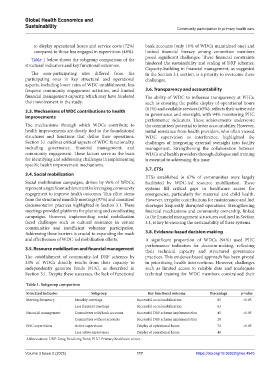
              Table 1 below shows the subgroup comparison of the   posed significant challenges. These financial constraints
            structural indicators and key functional outcomes.  hindered the sustainability and scaling of DRF schemes.
                                                               Capacity-building in financial management, as suggested
              The non-participating sites differed from the    in the Section 3.1 section, is a priority to overcome these
            participating ones in key structural and operational   challenges.
            aspects, including lower rates of WDC establishment, less
            frequent  community  engagement  activities,  and  limited   3.6. Transparency and accountability
            financial management capacity, which may have hindered   The ability of WDC to influence transparency at PHCs,
            their involvement in the study.                    such as ensuring the public display of operational hours
                                                               (61%) and available services (65%), reflects their active role
            3.3. Mechanisms of WDC contributions to health     in governance and oversight, with 94% monitoring PHC
            improvements
                                                               performance indicators. These achievements  underscore
            The mechanisms through which WDCs contribute to    the committees’ potential to foster accountability. However,
            health improvements are closely tied to the foundational   initial resistance from health providers, who often viewed
            structures and  functions  that define their  operations.   WDC supervision as interference, highlighted the
            Section 3.1 outlines critical aspects of WDC functionality,   challenges of integrating external oversight into facility
            including governance, financial management, and    management. Strengthening the collaboration between
            community engagement. These factors serve as the basis   WDCs and health providers through dialogue and training
            for identifying and addressing challenges in implementing   is essential to addressing this issue.
            specific health improvement mechanisms.
                                                               3.7. ETSs
            3.4. Social mobilization
                                                               ETSs established in 67% of communities were largely
            Social mobilization campaigns, driven by 96% of WDCs,   facilitated by WDC-led resource mobilization. These
            represent a significant achievement in leveraging community   systems fill critical gaps in healthcare access for
            engagement to improve health outcomes. This effort stems   emergencies, particularly for maternal and child health.
            from the structured monthly meetings (97%) and consistent   However, irregular contributions for maintenance and fuel
            documentation practices highlighted in Section 3.1. These   shortages frequently disrupted operations. Strengthening
            meetings provided platforms for planning and coordinating   financial mechanisms and community ownership, linked
            campaigns. However, implementing social mobilization   to the financial management structures outlined in Section
            faced challenges such as cultural resistance in certain   3.1, is key to ensuring the sustainability of these systems.
            communities and insufficient volunteer participation.
            Addressing these barriers is crucial to expanding the reach   3.8. Evidence-based decision-making
            and effectiveness of WDC-led mobilization efforts.  A  significant  proportion  of  WDCs  (94%)  used  PHC
                                                               performance indicators for decision-making, reflecting
            3.5. Resource mobilization and financial management  their technical capacity and structured governance
            The  establishment  of community-led DRF  schemes  by   practices. This evidence-based approach has been pivotal
            33% of WDCs directly results from their capacity to   in prioritizing health interventions. However, challenges
            independently generate funds (91%), as described in   such as limited access to reliable data and inadequate
            Section 3.1. Despite these successes, the lack of functional   technical training for WDC members constrained their

            Table 1. Subgroup comparison
            Structural indicator        Subgroup                Key functional outcome    Percentage    p-value
            Meeting frequency    Monthly meetings          Successful social mobilization    85         <0.05
                                 Less frequent meetings    Successful social mobilization    63
            Financial management  Committees with bank accounts  Successful DRF scheme implementation   45  <0.05
                                 Committees without accounts  Successful DRF scheme implementation   28
            PHC supervision      Active supervisors        Display of operational hours      72         <0.05
                                 Less active supervisors   Display of operational hours      48
            Abbreviations: DRF: Drug Revolving Fund; PHC: Primary healthcare center.


            Volume 3 Issue 2 (2025)                        117                       https://doi.org/10.36922/ghes.4945

