


Page 139 - GHES-3-2
P. 139
Global Health Economics and
            Sustainability
                                                                            The impact of PTSD on memory and cognition


            4. Discussion                                      symptoms. Overall, the memory test results obtained by
                                                               control group  A were superior to the tallies attained by
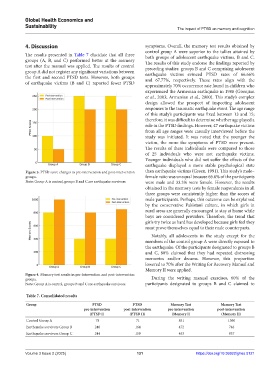
            The  results  presented  in  Table  7  elucidate  that  all  three   both groups of adolescent earthquake victims, B and C.
            groups (A, B, and C) performed better at the memory   The results of this study endorse the findings reported by
            test after the manual was applied. The results of control   preceding studies: groups B and C comprising adolescent
            group A did not register any significant variations between   earthquake victims evinced PTSD rates of 66.66%
            the first and second PTSD tests. However, both groups   and 67.77%, respectively. These rates align with the
            of earthquake victims (B and C) reported fewer PTSD   approximately 70% occurrence rate found in children who

                                                               experienced the Armenian earthquake in 1988 (Goenjian
                                                               et al., 2003; Armenian et al., 2000). This study’s complex
                                                               design allowed the prospect of inspecting adolescent
                                                               responses to the traumatic earthquake event. The age range
                                                               of this study’s participants was fixed between 13 and 15;
                                                               therefore, it was difficult to determine whether age played a
                                                               role in the PTSD findings. However, 47 earthquake victims
                                                               from all age ranges were casually interviewed before the
                                                               study was initiated. It  was noted that  the younger the
                                                               victim, the more the symptoms of PTSD were present.
                                                               The results of these individuals were compared to those
                                                               of 25 individuals who were not earthquake victims.
                                                               Younger individuals who did not suffer the effects of the
                                                               earthquake displayed a more stable psychological state
            Figure 3. PTSD score changes in pre-intervention and post-intervention   than earthquake victims (Green, 1991). This study’s male–
            groups.                                            female ratio was unequal because 66.6% of the participants
            Note: Group A is control, groups B and C are earthquake survivors.  were male and 33.3% were female. However, the results
                                                               obtained in the memory tests by female respondents in all
                                                               three groups were consistently higher than the scores of
                                                               male participants. Perhaps, this outcome can be explained
                                                               by the conservative Pakistani culture, in which girls in
                                                               rural areas are generally encouraged to stay at home while
                                                               boys  are  considered  providers.  Therefore,  the  trend  that
                                                               girls try twice as hard has developed because girls feel they
                                                               must prove themselves equal to their male counterparts.
                                                                 Notably, all adolescents in the study except for the
                                                               members of the control group A were directly exposed to
                                                               the earthquake. Of the participants designated to groups B
                                                               and  C,  80% claimed  that  they  had repeated  distressing
                                                               memories and/or dreams. However, this proportion
                                                               lowered to 70% after the Writing for Recovery Manual and
                                                               Memory II were applied.
            Figure 4. Memory test results in pre-intervention and post-intervention
            groups.                                              During the writing manual exercises, 60% of the
            Note: Group A is control, groups B and C are earthquake survivors.  participants designated to groups  B and C claimed to

            Table 7. Consolidated results
            Group                       PTSD             PTSD             Memory Test          Memory Test
                                     pre‑intervention   post‑intervention   pre‑intervention   post‑intervention
                                       (PTSD I)         (PTSD II)         (Memory I)           (Memory II)
            Control Group A               78               71                851                  1050
            Earthquake survivors Group B  240              164               472                  746
            Earthquake survivors Group C  244              159               453                  837


            Volume 3 Issue 2 (2025)                        131                       https://doi.org/10.36922/ghes.5121

