


Page 166 - GHES-3-2
P. 166
Global Health Economics and
            Sustainability
                                                                                      Online health community reviews


            two critical points as the emotional orientation threshold.
            According to the program, when the sentiment value
            is greater than 0.8, the review is considered a positive
            review; when the sentiment value is less than or equal to
            0.5, the review is considered a negative review; and when
            the sentiment value is between 0.5 and 0.8, the review is
            considered a neutral review. For instance, the review,
            “Excellent medical skills, striving for perfection. Warm
            attitude, kind words, patient guidance, careful diagnosis,
            formulation of a good plan, instructions for precautions,
            and finally, control of the disease always make us feel warm.
            Thank you very much, Director Bai!” had a sentiment value
            of 0.99, as calculated by SnowNLP; this review is regarded as
            a positive review. In contrast, another review states: “Doctor
            was impatient after talking with me for about 10 min. He did
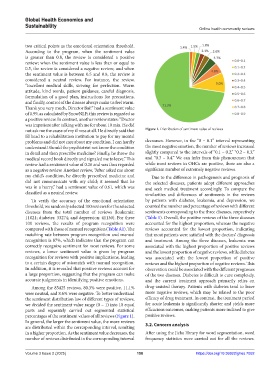
            not ask me the cause of my illness at all. He directly said that   Figure 1. Distribution of sentiment value of reviews
            I’d head to a rehabilitation institution to pay for my mental
            problems and did not care about my condition. I can hardly   decreases. However, in the “0 – 0.1” interval representing
            understand! Should the psychiatrist not know the condition   the most negative emotion, the number of reviews increased
            in detail and then prescribe medicine? Finally, he threw the   slightly compared to the intervals of “0.1 – 0.2,” “0.2 – 0.3,”
            medical record book directly and signaled me to leave.” This   and “0.3 – 0.4.” We can infer from this phenomenon that
            review had a sentiment value of 0.26 and was thus regarded   while most reviews in OHCs are positive, there are also a
            as a negative review. Another review, “After asked me about   significant number of extremely negative reviews.
            my child’s condition, he directly prescribed medicine and   Due to the difference in pathogenesis and prognosis of
            did not communicate with my child; it seemed that he   the selected diseases, patients adopt different approaches
            was in a hurry,” had a sentiment value of 0.61, which was   and seek medical treatment accordingly. To compare the
            classified as a neutral review.                    similarities and differences of sentiments in the reviews
              To verify the accuracy of the emotional orientation   by patients with diabetes, leukemia, and depression, we
            threshold, we randomly selected 100 reviews for the selected   counted the number and percentage of reviews with different
            diseases from the total number of reviews (leukemia:   sentiments corresponding to the three diseases, respectively
            11021; diabetes: 33274; and depression: 41130). For these   (Table 1). Overall, the positive reviews of the three diseases
            100  reviews, the results of program recognition were   accounted for the highest proportion, whereas the negative
            compared with those of manual recognition (Table A1). The   reviews accounted for the lowest proportion, indicating
            matching rate between program recognition and manual   that most patients were satisfied with the doctors’ diagnosis
            recognition is 87%, which indicates that the program can   and treatment. Among the three diseases, leukemia was
            correctly recognize sentiment for most reviews. For some   associated with the highest proportion of positive reviews
            reviews, a lower sentiment value is given by program   and the lowest proportion of negative reviews, while diabetes
            recognition for reviews with positive implications, leading   was associated with the lowest proportion of positive
            to a certain degree of mismatch with manual recognition.   reviews and the highest proportion of negative reviews. This
            In addition, it is revealed that positive reviews account for   observation could be associated with the different prognoses
            a large proportion, suggesting that the program can make   of the two diseases. Diabetes is difficult to cure completely,
            accurate judgments in identifying positive emotions.  and  the  current  treatment  approach  primarily  relies  on
              Among the 85425 reviews, 80.3% were positive, 11.1%   drug-assisted therapy. Patients with diabetes tend to leave
            were neutral, and 8.6% were negative. To better understand   more negative reviews, which may be related to the poor
            the sentiment distribution law of different types of reviews,   efficacy of drug treatment. In contrast, the treatment period
            we divided the sentiment value range (0 – 1) into 10 equal   for acute leukemia is significantly shorter and yields more
            parts and separately carried out segmented statistical   efficacious outcomes, making patients more inclined to give
            percentages of the sentiment values of all reviews (Figure 1).   positive reviews.
            In general, the larger the sentiment value, the more reviews   3.2. Concern analysis
            are distributed within the corresponding interval, resulting
            in a higher proportion. As the sentiment value decreases, the   After using the Jieba library for word segmentation, word
            number of reviews distributed in the corresponding interval   frequency statistics were carried out for all the reviews.


            Volume 3 Issue 2 (2025)                        158                       https://doi.org/10.36922/ghes.7052

