


Page 167 - GHES-3-2
P. 167
Global Health Economics and
            Sustainability
                                                                                      Online health community reviews


            As the primary subjects of these reviews are doctors and   the patients. In addition, the term “attitude” also constitutes
            patients, the terms “doctor” and “patient” had the highest   a significant proportion across all review types, highlighting
            frequency  count.  To  identify  other  keywords  in  the   the importance of the doctor’s attitude during diagnosis and
            reviews and analyze their relationship with the respective   treatment in the minds of patients. If a doctor meticulously
            diseases, we removed the terms “doctor” and “patient” and   treats the patient, receives them with kindness, or speaks in
            recalculated the word frequency from the reviews (Table 2).   a gentle tone, it creates a positive impression of the doctor’s
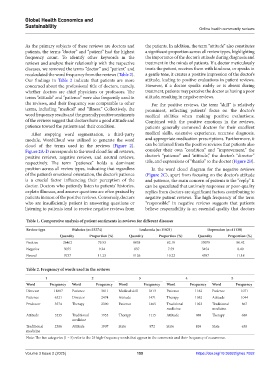
            Our findings in  Table 2 indicate that patients are more   attitude, leading to positive evaluations in patient reviews.
            concerned about the professional title of doctors, namely,   However, if a  doctor  speaks rudely or is  absent  during
            whether doctors are chief physicians or professors. The   treatment, patients may perceive the doctor as having a poor
            terms “attitude” and “patience” were also frequently used in   attitude, resulting in negative reviews.
            the reviews, and their frequency was comparable to other   For the positive reviews, the term “skill” is relatively
            terms, including “medical” and “illness.” Collectively, the   prominent,  reflecting patients’ focus on  the doctor’s
            word frequency results and the generally positive sentiments   medical abilities when making positive evaluations.
            of the reviews suggest that doctors have a good attitude and   Combined with the positive emotions in the reviews,
            patience toward the patients and their condition.  patients generally commend doctors  for their  excellent
              After stopping word segmentation, a third-party   medical  skills,  extensive  experience,  accurate  diagnosis,
            module,  WordCloud  was  utilized  to  generate  the  word   and appropriate medication prescriptions. Furthermore, it
            cloud of the terms used in the reviews (Figure  2).   can be inferred from the positive reviews that patients also
            Figure 2A-D corresponds to the word cloud for all reviews,   consider  their  own  “condition”  and “improvement,”  the
            positive reviews, negative reviews, and neutral reviews,   doctor’s  “patience” and  “attitude,”  the  doctor’s  “director”
            respectively. The term “patience” holds a dominant   title, and expressions of “thanks” to the doctor (Figure 2B).
            position across all review types, indicating that regardless   In  the  word  cloud  diagram  for the negative reviews
            of the patient’s emotional orientation, the doctor’s patience   (Figure 2C), apart from focusing on the doctor’s attitude
            is  a crucial  factor  influencing  their  perception  of  the   and patience, the main concern of patients is the “reply.” It
            doctor. Doctors who patiently listen to patients’ histories,   can be speculated that untimely responses or poor-quality
            explain illnesses, and answer questions are often praised by   replies from doctors are significant factors contributing to
            patients in most of the positive reviews. Conversely, doctors   negative patient reviews. The high frequency of the term
            who are insufficiently patient in answering questions or   “responsible” in negative reviews suggests that patients
            listening to patients tend to receive negative reviews from   believe responsibility is an essential quality that doctors

            Table 1. Comparative analysis of patient sentiments in reviews for different diseases
            Review type        Diabetes (n=33274)           Leukemia (n=11021)           Depression (n=41130)
                           Quantity    Proportion (%)   Quantity    Proportion (%)   Quantity     Proportion (%)
            Positive        26462          79.53          9058          82.19          33079          80.42
            Negative        3075           9.24           837           7.59           3454           8.40
            Neural          3737           11.23          1126          10.22          4597           11.18


            Table 2. Frequency of words used in the reviews
                    1                   2                   3                   4                  5
            Word      Frequency  Word     Frequency  Word     Frequency  Word     Frequency  Word    Frequency
            Director    11887   Patience    3811   Medical skill  1813  Patience    1182   Patience    1071
            Patience    6321    Director    2474   Attitude     1471    Therapy     1052   Attitude    1044
            Professor   3574    Therapy     2390   Patience     1465    Traditional   1023  Traditional   867
                                                                        medicine           medicine
            Attitude    3335    Traditional   1935  Therapy     1115    Attitude    888    Therapy      680
                                medicine
            Traditional   2306  Attitude    1907   State         972    State       838    State        630
            medicine
            Note: The five categories (1 – 5) refer to the 25 high-frequency words that appear in the comments and their frequency of occurrence.


            Volume 3 Issue 2 (2025)                        159                       https://doi.org/10.36922/ghes.7052

