


Page 216 - GHES-3-2
P. 216
Global Health Economics and
            Sustainability
                                                                             Health behaviors during COVID-19 pandemic


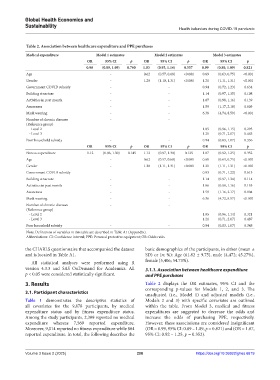
            Table 2. Association between healthcare expenditure and PPE purchases
            Medical expenditure           Model 1 estimates        Model 2 estimates        Model 3 estimates
                                      OR      95% CI     p    OR     95% CI      p     OR      95% CI     p
                                      0.98   (0.89, 1.09)  0.760  1.03  (0.93, 1.14)  0.557  0.99  (0.89, 1.09)  0.821
            Age                                 -             0.62  (0.57, 0.68)  <0.001  0.69  (0.63, 0.75)  <0.001
            Gender                              -             1.20  (1.10, 1.31)  <0.001  1.21  (1.11, 1.31)  <0.001
            Government COVID subsidy            -                        -             0.94   (0.72, 1.23)  0.634
            Building structure                  -                        -             1.14   (0.97, 1.35)  0.108
            Activities in past month            -                        -             1.07   (0.98, 1.16)  0.139
            Awareness                           -                        -             1.59   (1.17, 2.18)  0.003
            Mask wearing                        -                        -             6.38   (4.74, 8.59)  <0.001
            Number of chronic diseases          -                        -
            (Reference group)
             - Level 2                                                                 1.05   (0.96, 1.15)  0.295
             - Level 3                                                                 1.21   (0.71, 2.07)  0.483
            Poor household subsidy              -                        -             0.94   (0.83, 1.07)  0.336
                                      OR      95% CI     p    OR     95% CI      p     OR      95% CI     p
            Fitness expenditure       1.12   (0.96, 1.30)  0.145  1.12  (0.97, 1.30)  0.125  1.07  (0.92, 1.25)  0.352
            Age                                 -             0.62  (0.57, 0.68)  <0.001  0.68  (0.63, 0.75)  <0.001
            Gender                              -             1.20  (1.11, 1.31)  <0.001  1.21  (1.11, 1.31)  <0.001
            Government COVID subsidy            -                        -             0.93   (0.71, 1.22)  0.613
            Building structure                  -                        -             1.14   (0.97, 1.34)  0.114
            Activities in past month            -                        -             1.06   (0.98, 1.16)  0.153
            Awareness                           -                        -             1.59   (1.16, 2.17)  0.004
            Mask wearing                        -                        -             6.36   (4.72, 8.57)  <0.001
            Number of chronic diseases          -                        -
            (Reference group)
             - Level 2                                                                 1.05   (0.96, 1.14)  0.321
             - Level 3                                                                 1.21   (0.71, 2.07)  0.487
            Poor household subsidy              -                        -             0.94   (0.83, 1.07)  0.345
            Note: Definitions of variables in this table are described in Table A1 (Appendix).
            Abbreviations: CI: Confidence interval; PPE: Personal protective equipment; OR: Odds ratio.

            the CHARLS questionnaire that accompanied the dataset   basic demographics of the participants, in either (mean ±
            and is located in Table A1.                        SD) or (n; %): Age (61.82 ± 9.75), male (4,472; 45.27%),
              All statistical analyses were performed using R   female (5,406; 54.73%).
            version  4.3.3 and SAS OnDemand for Academics. All   3.1.1. Association between healthcare expenditure
            p < 0.05 were considered statistically significant.  and PPE purchases
            3. Results                                         Table  2 displays the OR estimates, 95% CI and the
                                                               corresponding  p-values for Models 1, 2, and 3. The
            3.1. Participant characteristics                   unadjusted (i.e., Model 1) and adjusted models (i.e.,
            Table  1 demonstrates the descriptive statistics of   Models  2 and 3) with specific covariates are outlined
            all covariates for the 9,878 participants, by medical   within the table. From Model 3, medical and fitness
            expenditure status and by fitness expenditure status.   expenditures are suggested to decrease the odds and
            Among the study participants, 2,309 reported no medical   increase  the odds  of purchasing  PPE, respectively.
            expenditure whereas 7,569 reported expenditure.    However, these associations are considered insignificant
            Moreover, 9,014 reported no fitness expenditure while 864   (OR = 0.99, 95% CI: 0.89 – 1.09, p = 0.821) and (OR = 1.07,
            reported expenditure. In total, the following describes the   95% CI: 0.92 – 1.25, p = 0.352).


            Volume 3 Issue 2 (2025)                        208                       https://doi.org/10.36922/ghes.6619

