


Page 217 - GHES-3-2
P. 217
Global Health Economics and
            Sustainability
                                                                             Health behaviors during COVID-19 pandemic


            Table 3. Association between healthcare expenditure and daily expenditure coverage
            Medical expenditure                 Model 4 estimates     Model 5 estimates     Model 6 estimates
                                            OR    95% CI     p    OR     95% CI    p     OR    95% CI     p
                                            0.77  (0.69, 0.85)  <0.001  0.73  (0.66, 0.81)  <0.001  0.74  (0.67, 0.83)  <0.001
            Age                                       -           1.65  (1.51, 1.80)  <0.001  1.76  (1.61, 1.93)  <0.001
            Gender                                    -           0.89  (0.82, 0.97)  0.007  0.89  (0.81, 0.97)  0.007
            Government COVID subsidy                  -                     -            1.11  (0.84, 1.46)  0.457
            Building structure                        -                     -            1.08  (0.92, 1.28)  0.351
            Activities in past month                  -                     -            1.21  (1.11, 1.32)  <0.001
            Awareness                                 -                     -            1.40  (1.06, 1.86)  0.019
            Mask wearing                              -                     -            0.99  (0.82, 1.21)  0.952
            Number of chronic diseases (Reference group)  -                 -
             - Level 2                                                                   0.84  (0.76, 0.92)  <0.001
             - Level 3                                                                   0.33  (0.18, 0.62)  <0.001
            Poor household subsidy                    -                     -            0.64   (0.56, 0.73)  <0.001
                                            OR    95% CI     p    OR     95% CI    p     OR    95% CI     p
            Fitness expenditure             1.37   (1.18, 1.61)  <0.001  1.36  (1.17, 1.59)  <0.001  1.35  (1.16, 1.57)  <0.001
            Age                                       -           1.61  (1.48, 1.76)  <0.001  1.72  (1.58, 1.88)  <0.001
            Gender                                    -           0.89  (0.81, 0.97)  0.006  0.89  (0.81, 0.97)  0.006
            Government COVID subsidy                  -                     -            1.09  (0.83, 1.43)  0.545
            Building structure                        -                     -            1.08  (0.91, 1.27)  0.381
            Activities in past month                  -                     -            1.19  (1.09, 1.30)  <0.001
            Awareness                                 -                     -            1.39  (1.05, 1.84)  0.023
            Mask wearing                              -                     -            0.97  (0.80, 1.17)  0.734
            Number of chronic diseases (Reference group)  -                 -
             - Level 2                                                                   0.81  (0.74, 0.89)  <0.001
             - Level 3                                                                   0.32  (0.17, 0.60)  <0.001
            Poor household subsidy                    -                     -            0.64  (0.56, 0.73)  <0.001
            Note: Definitions of variables in this table are described in Table A1 (Appendix).
            Abbreviations: CI: Confidence interval; OR: Odds ratio.

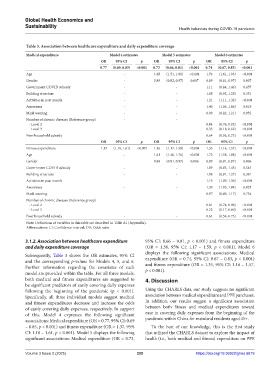
            3.1.2. Association between healthcare expenditure   95% CI: 0.66 – 0.81,  p < 0.001) and fitness expenditure
            and daily expenditure coverage                     (OR = 1.36, 95% CI: 1.17 – 1.59,  p < 0.001). Model 6
            Subsequently,  Table  3 shows the OR estimates, 95% CI   displays the following significant associations: Medical
            and the corresponding  p-values for Models 4, 5, and 6.   expenditure (OR = 0.74, 95% CI: 0.67 – 0.83, p < 0.001)
            Further information regarding the covariates of each   and fitness expenditure (OR = 1.35, 95% CI: 1.16 – 1.57,
            model are provided within the table. For all three models,   p < 0.001).
            both medical and fitness expenditures are suggested to   4. Discussion
            be significant predictors of easily covering daily expenses
            following the beginning of the pandemic (p < 0.001).   Using the CHARLS data, our study suggests no significant
            Specifically, all three individual models suggest medical   association between medical expenditure and PPE purchases.
            and fitness expenditures decrease and increase the odds   In  addition,  our  results  suggest  a  significant  association
            of easily covering daily expenses, respectively. In support   between both fitness  and medical  expenditures toward
            of  this,  Model  4  expresses  the  following  significant   ease in covering daily expenses from the beginning of the
            associations: Medical expenditure (OR = 0.77, 95% CI: 0.69   pandemic within China for mainland residents aged 45+.
            – 0.85, p < 0.001) and fitness expenditure (OR = 1.37, 95%   To the best of our knowledge, this is the first study
            CI: 1.18 – 1.61, p < 0.001). Model 5 displays the following   that utilized the CHARLS dataset to explore the impact of
            significant associations: Medical expenditure (OR = 0.73,   health (i.e., both medical and fitness) expenditure on PPE


            Volume 3 Issue 2 (2025)                        209                       https://doi.org/10.36922/ghes.6619

