


Page 151 - GHES-3-3
P. 151
Global Health Economics and
            Sustainability
                                                                                             A comparative analysis


                          A                                    B


                          C                                    D


                          E                                    F


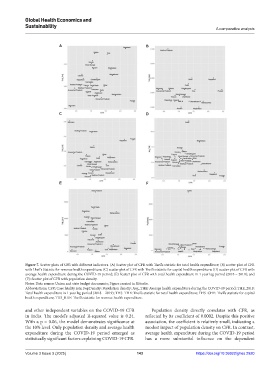
            Figure 7. Scatter plots of CFR with different indicators. (A) Scatter plot of CFR with Theil’s statistic for total health expenditure; (B) scatter plot of CFR
            with Theil’s Statistic for revenue health expenditure; (C) scatter plot of CFR with Theil’s statistic for capital health expenditure; (D) scatter plot of CFR with
            average health expenditure during the COVID-19 period; (E) Scatter plot of CFR with total health expenditure in 1 year lag period (2018 – 2019); and
            (F): Scatter plot of CFR with population density.
            Notes: Data source: Union and state budget documents; Figure created in RStudio.
            Abbreviations: CFR: Case fatality rate; PopDensity: Population density; Avg_THE: Average health expenditure during the COVID-19 period; THE_2018:
            Total health expenditure in 1 year lag period (2018 – 2019); THS_THE: Theil’s statistic for total health expenditure; THS_CHE: Theil’s statistic for capital
            health expenditure; THS_RHE: Theil’s statistic for revenue health expenditure.


            and other independent variables on the COVID-19 CFR   Population density directly correlates with CFR, as
            in India. The model’s adjusted R-squared value is 0.24.   reflected by its coefficient of 0.0002. Despite this positive
            With a p = 0.06, the model demonstrates significance at   association, the coefficient is relatively small, indicating a
            the 10% level. Only population density and average health   modest impact of population density on CFR. In contrast,
            expenditure during the COVID-19 period emerged as   average health expenditure during the COVID-19 period
            statistically significant factors explaining COVID-19 CFR.  has a more substantial influence on the dependent


            Volume 3 Issue 3 (2025)                        143                       https://doi.org/10.36922/ghes.2920

