


Page 152 - GHES-3-3
P. 152
Global Health Economics and
            Sustainability
                                                                                             A comparative analysis


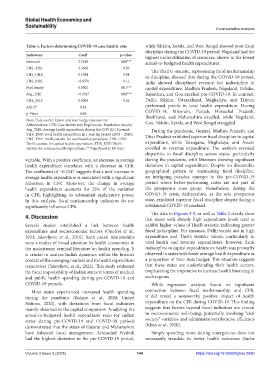
            Table 5. Factors determining COVID‑19 case fatality rate  while Sikkim, Kerala, and West Bengal showed poor fiscal
                                                               discipline during the COVID-19 period. Nagaland had the
            Indicators            Coeff             p‑value    highest underutilization of resources, shown in the lowest
            Intercept             2.5540            0.00***    actual-to-budgeted health expenditures.
            THS_THE               3.3640             0.20        The Theil U-statistic, representing fiscal marksmanship
            THS_CHE               0.1084             0.84      or discipline, showed that during the COVID-19 period,
            THS_RHE               −8.6570            0.11      India showed disciplined revenue but indiscipline in
            PopDensity            0.0002            0.01***    capital expenditure. Madhya Pradesh, Nagaland, Odisha,
            Avg_THE               −0.2547           0.00***    Rajasthan, and Goa excelled pre-COVID-19. In contrast,
            THE_2018              0.0000             0.26      Delhi, Sikkim, Uttarakhand, Meghalaya, and Tripura
            Adj. R 2               0.24                        performed poorly in total health expenditure. During
            p-Value                0.06                        COVID-19,  Mizoram,  Punjab,  Himachal Pradesh,
                                                               Jharkhand, and Maharashtra excelled, while Nagaland,
            Note: Data source: Union and state budget documents.  Goa, Sikkim, Kerala, and West Bengal struggled.
            Abbreviations: CFR: Case fatality rate; PopDensity: Population density;
            Avg_THE: Average health expenditure during the COVID-19 period;   During the pandemic, Gujarat, Madhya Pradesh, and
            THE_2018: Total health expenditure in 1 year lag period (2018 – 2019);   Uttar Pradesh exhibited superior fiscal discipline in capital
            THS_THE: Theil’s statistic for total health expenditure; THS_CHE:
            Theil’s statistic for capital health expenditure; THS_RHE: Theil’s   expenditure, while Telangana, Meghalaya, and Assam
            statistic for revenue health expenditure; ***Significant at 1% level.  excelled in revenue expenditure. The analysis revealed
                                                               disparities in fiscal discipline across states, particularly
            variable. With a positive coefficient, an increase in average   during the pandemic, with Mizoram showing significant
            health expenditure correlates with a decrease in CFR.   deviation in capital expenditure. Despite no discernible
            The coefficient of −0.2547 suggests that a unit increase in   geographical pattern in maintaining fiscal discipline,
            average health expenditure is associated with a significant   an intriguing paradox emerges in the pre-COVID-19
            reduction  in  CFR.  Moreover,  the  change  in  average   period where better-performing states are not part of
            health expenditure accounts for 25% of the variation   the prosperous state group. Nonetheless, during the
            in CFR, highlighting  its substantial  explanatory power.   COVID-19 crisis, Maharashtra, as the sole prosperous
            In this analysis, fiscal marksmanship indicators do not   state, exhibited superior fiscal discipline despite facing a
            significantly influence CFR.                       substantial COVID-19 caseload.
                                                                 The data in Figures 2-5, as well as Table 2 clearly show
            4. Discussion                                      that states with already high expenditure levels tend to
            Several studies established a link between health   exhibit higher values of Theil’s statistic, indicating greater
            expenditure and socioeconomic factors (Onofrei  et al.,   fiscal indiscipline. For instance, Delhi stands out in high
            2021; Jakovljevic  et al., 2016). Such causal relationships   expenditure and Theil’s statistic values, particularly in
            were a matter of broad attention by health economists in   total health and revenue expenditures; however, fiscal
            the mainstream seminal literature on health spending. It   indiscipline in capital expenditure on health was primarily
            is crucial to analyze India’s dynamics within the broader   observed in states with lower average health expenditure as
            context of the emerging markets and its health expenditure   a proportion of their state budget. This situation suggests
            trajectories (Jakovljevic et al., 2022). This study evaluated   that these states are underfunding their health sectors,
            the fiscal responsibility of Indian states in terms of medical   emphasizing the imperative to increase health financing in
            and public health spending during pre-COVID-19 and   such regions.
            COVID-19 periods.                                    While regression analysis found no significant

              Most states experienced increased health spending   connection between fiscal marksmanship and CFR,
            during the pandemic (Balajee  et al., 2020; United   it did reveal a noteworthy positive impact of health
            Nations, 2020), with deviations from fiscal indicators   expenditure on the CFR during COVID-19. This finding
            mainly observed in the capital component. Analyzing the   suggests that factors beyond fiscal indicators are crucial
            actual-to-budgeted health expenditure ratio for Indian   in socioeconomic well-being, potentially involving “civil
            states  during  pre-COVID-19  and  COVID-19  periods   society” variables and administrative/allocative efficiency
            demonstrated that the states of Gujarat and Maharashtra   (Khan et al., 2020).
            have balanced fiscal management. Arunachal Pradesh   Simply spending more during emergencies does not
            had the highest deviation in the pre-COVID-19 period,   necessarily translate to better health outcomes (Sachs


            Volume 3 Issue 3 (2025)                        144                       https://doi.org/10.36922/ghes.2920

