


Page 163 - GHES-3-3
P. 163
Global Health Economics and
            Sustainability
                                                                 Sustainable procurement in healthcare to address value chain


            3.1. Post-training results

            The results indicated that participants demonstrated
            significant improvement in their awareness levels across
            all six questions; 93% of participants understood that
            sustainable  procurement is  beneficial;  the  responses  of
            30  questions  were  analyzed and  the  average  score  was
            19.4/30 (64.7%) with a 95% confidence interval of 18.7–
            20.1, suggesting moderate to strong understanding from
            the program attended on sustainable procurement.
              In addition, 87% of participants connected Greenhouse
            gases (GHG) emissions (scopes 1, 2, and 3), with climate
            change. Carbon footprint is defined by the emissions
            of GHG caused within boundary of the organization
            (Direct emission) and is measured as scope 1, Scope 2 is   Figure 7. Responses to the question: “What is sustainable procurement?”
                                                               Abbreviation: ESG: Environment, social, and governance.
            the indirect emissions caused by purchase of electricity/
            steam which is generated elsewhere but consumed onsite
            causing indirect emissions for organization. Scope 3 is   environmental, and social issues connected with their
            associated with value chain emissions from upstream and   organizations  and  maintain  performance.”  This  suggests
            downstream requiring engagement with supply chain   that participants have started recognizing the importance
            upstream and downstream of the value chain associated   of considering ESG factors when selecting vendors,
            with the organization to take mitigation action. The results   following the program.
            showed 87% of the participants agreeing inventory of   Moreover, 40% of participants concurred with the
            carbon emissions under scope1, 2, and 3 is crucial and 68%   procurement approach that involves supplier evaluation for
            of participants believed that engaging vendors in climate   ESG risks, coupled with contractual agreements, ensuring
            risk management should be part of the solution. Regarding   compliance with ESG standards. This underscores the
            the benefits of sustainable procurement, participants   increasing awareness among participants of the importance
            highlighted cost saving (85%), risk mitigation in the supply   of mitigating ESG risks throughout the procurement
            chain (79%), and proper governance (92%). Likewise, 94%   process.
            of respondents supported the adoption of a sustainable   Interestingly, 21% of participants favored the procurement
            procurement policy, and 90% emphasized the need to
            baseline supplier performance.                     practice of assessing supplier performance through on-site
                                                               audits, indicating a significant segment that values direct
            3.2. Awareness of sustainable procurement          verification of sustainability practices. Furthermore, 15%
                                                               of participants endorsed both procurement methods,
            The  present  study  observed  that  the  CAHO  masterclass   underscoring their belief in the importance of cost-
            program ignited the momentum for sustainable       efficiency while maintaining quality standards. Notably,
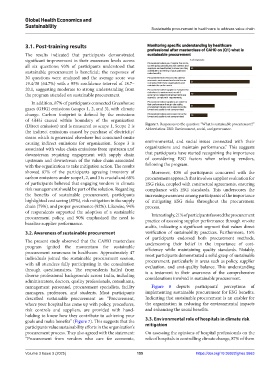
            procurement  awareness  in  healthcare.  Approximately  47   most participants demonstrated a solid grasp of sustainable
            individuals joined the sustainable procurement session,   procurement, particularly in areas such as policy, supplier
            with all attendees fully participating in the consultation   evaluation,  and  cost-quality  balance.  This  understanding
            through questionnaires. The respondents hailed from   is a testament to their awareness of the comprehensive
            diverse professional backgrounds across India, including   considerations involved in sustainable procurement.
            administrators, doctors, quality professionals, consultants,
            management personnel, procurement specialists, facility   Figure  8 depicts participants’ perceptions of
            managers, professors, and students. Most participants   implementing sustainable procurement for ESG benefits.
            described sustainable  procurement  as:  “Procurement,   Indicating that sustainable procurement is an enabler for
            where your hospital has come up with policy, procedures,   the organization in reducing the environmental impacts
            risk controls  and suppliers, are provided with hand-  and enhancing the social benefits.
            holding to know how they contribute to achieving your
            goals and make benefits” (Figure 7). This suggests that the   3.3. Environmental role of hospitals in climate risk
            participants value sustainability efforts in the organization’s   mitigation
            procurement process. They also agreed with the statement:   On assessing the opinions of hospital professionals on the
            “Procurement from vendors who care for economic,   role of hospitals in controlling climate change, 87% of them


            Volume 3 Issue 3 (2025)                        155                       https://doi.org/10.36922/ghes.5663

