


Page 164 - GHES-3-3
P. 164
Global Health Economics and
            Sustainability
                                                                 Sustainable procurement in healthcare to address value chain


                                                               Count of Q3.   Scope 1, 2  None of above Scope 1 Scope 2
                                                               Climate change is   and 3
                                                               risk combatted by
                                                               controlling
                                                                                87%       2%       6%    4%
                                                               Figure 9. Response to the association between carbon footprint reduction
                                                               and climate change risks by working on inventorising and mitigating
                                                               scope 1, 2 and 3 emissions

                                                               Count of Q4. Upstream and   None  Scope 1 Scope 2 Scope 3
                                                               Downstream Vendors are   of the
                                                               highly the target group for   above
                                                               Climate risk mitigation and
                                                               its part of which of the below
            Figure 8. Response to environmental and social outcomes                   13%   9%    11%    68%
                                                               Figure 10. Response to the association between vendor involvement and
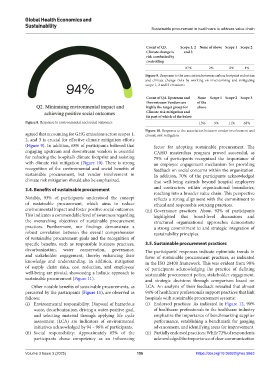
            agreed that accounting for GHG emissions across scopes 1,   climate risk mitigation
            2, and 3 is crucial for effective climate mitigation efforts
            (Figure 9). In addition, 68% of participants believed that   factor for adopting sustainable procurement. The
            engaging upstream and downstream vendors is essential   CAHO masterclass program proved successful, as
            for reducing the hospital’s climate footprint and assisting   79% of participants recognized the importance of
            with climate risk mitigation (Figure 10). There is strong   an employee engagement mechanism for providing
            recognition of the environmental and social benefits of   feedback on social concerns within the organization.
            sustainable procurement, but vendor involvement in    In addition, 70% of the participants acknowledged
            climate risk mitigation should also be emphasized.    that well-being extends beyond hospital employees

            3.4. Benefits of sustainable procurement              and contractors within organizational boundaries,
                                                                  reaching into a broader value chain. This perspective
            Notably, 93% of participants understood the concept   reflects a strong alignment with the commitment to
            of sustainable procurement, which aims to reduce      ethical and responsible sourcing practices.
            environmental impact and foster positive social outcomes.   (iii) Governance practices: About 92% of participants
            This indicates a commendable level of awareness regarding   highlighted that board-level discussions  and
            the overarching objectives of sustainable procurement   structured organizational approaches demonstrate
            practices. Furthermore, our findings demonstrate a    a strong commitment to and strategic integration of
            robust correlation between the overall comprehension   sustainability principles.
            of sustainable procurement goals and the recognition of
            specific benefits, such as responsible business practices,   3.5. Sustainable procurement practices
            decarbonization,  water  conservation,  governance,  The participants’ responses indicate optimistic trends in
            and stakeholder engagement, thereby enhancing their   favor of sustainable procurement practices, as indicated
            knowledge and understanding. In addition, mitigation   in the ISO 20400 framework. This was evident from 98%
            of supply chain risks, cost reduction, and employees’   of participants acknowledging the practice of defining
            well-being are pivotal, showcasing a holistic approach to   sustainable procurement policy, stakeholder engagement,
            sustainable procurement (Figure 11).               and strategic decisions through comparison based on
              Other notable benefits of sustainable procurements, as   LCA. An analysis of their feedback revealed that almost
            perceived by the participants (Figure 11), are observed as   94% of healthcare professionals support practices that link
            follows:                                           hospitals with sustainable procurement systems:
            (i)  Environmental responsibility: Disposal of hazardous   (i)  Endorsed practices: As indicated in  Figure  12, 90%
               waste, decarbonization, driving a water-positive goal,   of healthcare professionals in the healthcare industry
               and selecting material through applying life cycle   emphasize the importance of benchmarking supplier
               assessment (LCA) are indicators of environmental   performance,  establishing  a  benchmark  for  gauging
               initiatives acknowledged by 94 – 96% of participants.  advancement, and identifying areas for improvement.
            (ii)  Social responsibility: Approximately 85% of the   (ii)  Partially endorsed practices: While 72% of respondents
               participants chose competency as an influencing    acknowledged the importance of clear communication


            Volume 3 Issue 3 (2025)                        156                       https://doi.org/10.36922/ghes.5663

