


Page 245 - GHES-3-3
P. 245
Global Health Economics and
            Sustainability
                                                                               Empirical resource allocation in healthcare


            particularly at the lower and higher rank extremes, despite   Similarly, rank-size dependencies were constructed on
            a coefficient of determination close to 0.8. This lack of   the number of specialist surgical workforce (Figure 4) and
            approximation may arise due to: sampling biases and the   the hospital beds (Figure 5). The deviations from a linear
            lack of representativeness at both low and high ranks; and   rank-size dependence observed for these resources further
            the limited applicability of the lognormal distribution in   confirm the disparity in their distribution. The obtained
            capturing extreme values.                          specifications for both specialist surgical workforce and
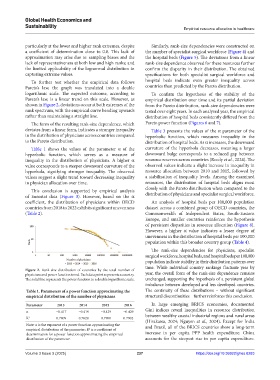
              To further test whether the empirical data follows   hospital beds indicate even greater inequality across
            Pareto’s law, the  graph was translated into a double   countries than predicted by the Pareto distribution.
            logarithmic scale. The expected outcome, according to   To confirm the hypothesis of the stability of the
            Pareto’s law, is a linear trend on this scale. However, as   empirical distribution over time and its partial deviation
            shown in Figure 2, deviations occur at both extremes of the   from the Pareto distribution, rank-size dependencies were
            rank spectrum, with the empirical curve bending upwards   tested over eight years. In each analyzed year, the empirical
            rather than maintaining a straight line.           distribution of hospital beds consistently differed from the
              The form of the resulting rank-size dependence, which   Pareto power function (Figures 6 and 7).
            deviates from a linear form, indicates a stronger inequality   Table 3 presents the values of the α parameter of the
            in the distribution of physicians across countries compared   hyperbolic function, which measures inequality in the
            to the Pareto distribution.                        distribution of hospital beds. As α increases, the downward
              Table 1 shows the values of the parameter  α of the   curvature of the hyperbola decreases, meaning a larger
            hyperbolic function, which serves as a measure of   downward bulge corresponds to a reduced gap between
            inequality  in  the  distribution  of  physicians.  A  higher  α   resource reserves across countries (Reedy et al., 2024). The
            value corresponds to a steeper downward curvature of the   observed values indicate a slight increase in inequality in
            hyperbola, signifying stronger inequality. The observed   resource allocation between 2010 and 2015, followed by
            values suggest a slight trend toward decreasing inequality   a stabilization of inequality levels. Among the examined
            in physician allocation over time.                 resources, the distribution of hospital beds aligns most
                                                               closely with the Pareto distribution when compared to the
              This conclusion is supported by empirical analysis
            of Eurostat data (Figure  3). However, based on the  α   distribution of physicians and specialist surgical workforce.
            coefficient, the distribution of physicians within OECD   An analysis of hospital beds per 100,000 population
            countries from 2018 to 2022 exhibits significant unevenness   dataset across a combined group of OECD countries, the
            (Table 2).                                         Commonwealth of Independent States, South-Eastern
                                                               Europe, and smaller countries reinforces the hypothesis
                                                               of persistent disparities in resource allocation (Figure 8).
                                                               However, a higher  α value indicates a lesser degree of
                                                               unevenness in the distribution of hospital beds per 100,000
                                                               population within this broader country group (Table 4).
                                                                 The rank-size dependencies for physicians, specialist
                                                               surgical workforce, hospital beds, and hospital beds per 100,000
                                                               population indicate stability in their distribution patterns over
                                                               time. While individual country rankings fluctuate year by
            Figure  2. Rank-size distribution of countries by the total number of
            physicians and power function trend. Each data point represents a country.   year, the overall form of the rank-size dependence remains
            The solid line represents the power function in a double logarithmic scale.  unchanged, supporting the hypothesis of a persistent global
                                                               imbalance between developed and less developed countries.
            Table 1. Parameters of a power function approximating the   The continuity of these distributions – without significant
            empirical distribution of the number of physicians  structural discontinuities – further reinforces this conclusion.
            Parameter    2013      2014     2015      2016       In large emerging BRICS economies, documented
            α            −0.417   −0.419    −0.429   −0.429    Gini indices reveal inequalities in resource distribution
            R 2          0.7809    0.7828   0.7900    0.7902   between wealthy coastal industrial regions and rural areas
                                                               (Hirakawa,  2024; Nguyen  et al., 2024).  Except for  India
            Note: α is the exponent of a power function approximating the   and Brazil, all of the BRICS countries show a long-term
            empirical distribution of the parameter; R  is a coefficient of
                                       2
            determination for a power function approximating the empirical   increase in per capita PPP health expenditure. China
            distribution of the parameter.                     accounts for the steepest rise in per capita expenditure.

            Volume 3 Issue 3 (2025)                        237                       https://doi.org/10.36922/ghes.8283

